Showing posts with label foraging. Show all posts

Monday, 28 July 2014

A most successful hunt (and a toad)

End of July is the time when the forest starts displaying significant edible fungus diversity. I was counting on seeing many different kinds of mushrooms, but certainly not filling the basket. This is normally for August, the high mushroom season. But the recent warm weather, coupled with ample rain has urged fungi to fruit in greater numbers than usual.

The first encounter was a family of humble russulas -

A bit useless in the pot, but always an indication that better goods are nearby
Then some giant chanterelles hiding under heather -

Many more to come this trip!
 A sudden movement in the undergrowth -

Not a deer. Thank goodness for that!
Right next to it, a beautiful cep -

Good enough for a desktop background, not to mention my basket
A lone Amanita, probably rubescens (edible), but the first rule of mushroom hunter who wishes to die of natural causes is as follows: NEVER put an amanita into your basket.

Best left alone
A little bit further into the woods there was a large clearing, partly overgrown with heather, with lots and lots of chanterelles -

These, and about a thousand more nearby - all ripe for picking
These chanterelles were growing under birch trees, so the next encounter was not unexpected -

Brown birch bolete, in perfect condition
As well as the one after that -

Orange birch bolete. Highly unusual to see one in July.
Further on the forest path, a lurid bolete -

Not only beautiful, but also edible after a bit of boiling
And another perfect cep specimen -

Delightful!
Not far from it, some common deceivers. My basket was already full at that point (all those chanterelles!), and in any case they are hardly worth taking due to their small size and lack of taste. Still, they are certainly good enough for a photo -

Lovely colours!
And so the foraging trip ended. The final result is in the photo below. It took me the whole of the next day to process all those chanterelles, and my family has been complaining that the fungal component of their diet has become somewhat overwhelming. But they needn't suffer any more: I got a solution for that. More about it later!

Clockwise from mid-left: slippery jack, bay bolete, four brown birch boletes, six ceps (and a cap), two saffron milk caps, orange birch bolete, lurid bolete and many, many, many chanterelles. A great haul, especially considering the time of year.

Tuesday, 22 July 2014

Some internet trolls

Do trolls like mushrooms? Anyway - breakfast is served!

Milky tea and chanterelle mushroom pie
After this, I had a most productive day in the forest - here is the teaser. Detailed report to follow!


Tuesday, 15 July 2014

Mostly frogs

I started off to the forest last Saturday hoping to get some first ceps, thinking that even though there hasn't been much rain lately, it should still be wet enough deep in the forest for some fungal goodness to emerge.

Just on the edge, I found this fungus -

Grey-spotted amanita
These fungi are apparently edible, but rules are rules: no amanitas in my basket! Ever. Its mere presence however was a most encouraging sign, meaning that my hopes for ceps were not unfounded.

But for the next hour or so, all I saw was this little critter, and hundreds and possibly thousands of its brothers and sisters, all hadly bigger than my little fingernail, hopping across paths and clearings to their promised ponds, or whatever counts as amphibian paradise:

So adorable!
So only much later, when I went right into the very heart of the forest, did I set my eyes on this magnificent sight -

What can I say - magnificent.
Not much to tell afterwards. There was a giant chanterelle -

Didn't know they could grow this huge
And then I got lost. Yes, that's right. In my home forest, which I know like the back of my palm. It was all because of logging. It's claimed to be "good forest management", but I really fail to see how it can be useful. Forests have been around for much longer than humans, and they somehow managed to manage themselves. Anyway, I mixed up paths because they no longer looked the same as they were last year, and took a wrong turn. After 15 minutes, I had my first doubts. This marshy patch looks familiar... Then even more doubts. This rabbit net looks just like the one I passed two hours ago... And then, finally - Those three rotten mushrooms on a log - oh dear, I'm about two miles away from the spot I thought I would be.

And that was it. The haul wasn't great, but the season hasn't really started yet, so I shouldn't complain. It has been raining more this week, so from here things can only get better!

Three ceps, one bay bolete, chanterelles, and wild raspberries and strawberries.

Wednesday, 25 June 2014

Second chanterelle hunt

It has been fairly dry recently, so I didn't have high hopes for my foraging trip last weekend. But despite the lack of moisture, chanterelles were still growing, surprisingly more on sandy soil of the Tayport heath than deeper in the forest.

Deviating slightly from the path I took the previous week, I also found a semi-decayed lurid bolete, and a couple of overripe bay boletes. A forager's nightmare, this is. If only I took five steps to the left/right/off the path/took another turn (underline as required). Ah, well, you win some, you lose some.

And here are the trip results - all destined to go into a cream sauce a couple of days later:

About 500g here - already slightly dried out, but still good

Tuesday, 17 June 2014

First foray of 2014

This Saturday, as planned, I took to the forest in the hope of finding some mushrooms. I was expecting perhaps a few chanterelles, as it is still very early in the season, so only took a couple of small plastic containers with me.

Even before entering the forest, I knew that I should have taken more: the amount of fungal variety was much greater than you'd expect in mid-June. Firstly, puffballs:

Edible when young (like pictured)
Then, a beautiful red russula, complete with a slug -

Isn't it adorable how it is reaching out for food
And then finally, the stars of the show -

In significant numbers, too!
A nice looking fungus that I unfortunately I could not identify -

Rule No.1: if you can't positively identify it, don't take it, no matter how tempting it looks
Deeper in the forest, some slime moulds were munching their way trough moss and leaf litter -

It's yellow, but it's not a chanterelle
Overall, it was a much more successful trip than I expected. I even had to limit myself to taking the largest chanterelles so that I wouldn't run out of container space - very unusual at this time of year. One slight disappointment was that strawberries, which I expected to find in great abundance, were not quite ready yet. It has been fairly warm, but obviously not quite enough sunshine to let them mature properly. I'll just have to visit the patch in a week or so.

The grand total of the day:

That'll do Pig. That'll do :-)

Tuesday, 1 October 2013

Meanwhile, in the East...

Mushroom season here in Scotland is ending, but this is clearly not the case in other places. Consider this foraging report I got from a friend in Germany:

Ceps, lurid boletes and a few bay boletes - very nice haul!
But it is the Ukrainian report that makes me truly jealous. Saffron milk caps. SAFFRON MILK CAPS!!

Maybe I'm living in a wrong country...

Monday, 30 September 2013

At the end of the season

I had a wonderful time in the forest this Sunday. The mushrooming season is clearly coming to a close, but I must confess that despite the scarcity of fungi, these last trips I find the most pleasurable of all. Mostly, because of the declining number of blood-sucking insects. A good repellent does away with 99% of the problem, but the remaining 1% can really hurt. Another reason, perhaps unexpectedly, is that there are fewer mushrooms.

Yes, that's right! When there are many mushrooms, they are harder to carry home, and also collecting them is a routine and not an adventure that it should be. Early August, every mushroom is just a +1 for the freezer. Late September, each and every one is an achievement and testimony to a mushroom hunter's skill.

And here was the first set - Lycoperdon perlatum:

Not that spectacular, perhaps, but edible and abundant
In fact, I have never cooked these before, so there is the challenge for tomorrow. After that, one of the forest staples:

Brown birch bolete - not the most amazing mushroom in existence, but every little helps!
Not long after - a whole family of slippery jacks:

Now, there is enough for supper in the basket!
Next, a perfect specimen of a fly agaric. Left it alone, of course, but kept my eyes peeled, because where there are fly agarics, there would be ceps, too.

If only it were edible... but so beautiful!
And then, right next to it - I couldn't believe my eyes! So late in the season, but there is was:

A cep! Touched by mould a bit, but still edible.
And here is the complete crop of the day. Just enough for tea!

Pearly puffballs (top left, brown birch boletes (centre), bay bolete (top right), chanterelles (bottom right),
cep (centre left), and slippery jacks all over the place.

Monday, 23 September 2013

Forest gems

Late September is the end of mushroom season in Scotland, so when setting out on my usual route this Sunday I wasn't expecting much to put into my basket. On a day like that it hardly matters though: the walk would have been rewarding even without any finds. Sunshine, gentle wind, the smell of heated pine needles, a few mosquitoes... OK, mosquitoes were not a welcome thing, but that's what insect repellent is for, right?

For the first couple of hours, I was only finding false chanterelles, lots of them. Very fine specimens, though:

If only it were real! Note the crowded forked gills that distinguish this fungus from the true chanterelle.
I could have picked hundreds of them, but alas - they are quite inedible, although not bad-looking, I must admit.

Then, finally something to put into my basket. Nearly stepped on it!

Small, but firm and maggot-free
An hour later, a nice find on a mossy forest path. I'm not greatly excited by brown birch boletes, but so late in the mushroom year, attitudes change.

No time to be fussy! Get into the basket, my friend.
On the final stretch, the path took me through an ancient beech wood, where the leaf litter layer was so thick that it was like walking on a mattress. And there I found them! Several hundreds of fresh, shiny, purple amethyst deceivers, Laccaria amethystina. Also, a few true chanterelles mixed up with them as a bonus, and a small cep, too!

Gem of the woods: extraordinary colour (and yes, it is edible)
I'll write more about these beautiful fungi later this week. They made my day!

The complete crop: top left - brown birch boletus; top - two slippery jacks; right - a couple of hundred of amethyst
deceivers; centre - saffron milk cap (sadly, all maggoty despite to good looks); bottom - golden chanterelles;
bottom left - two ceps. An excellent haul, considering the timing. Cooking report coming up!

Friday, 20 September 2013

This might be infectious...

Wonderful crop from Ukraine
I have a Ukrainian friend who has never been interested in collecting mushrooms. She is (or maybe was - see below) a committed gardener. If you have read Karel Čapek's The Gardener's Year, you'll know what I'm talking about. If not, I have placed my translation of the Gardener's prayer from the book at the bottom of this post, so that you can get the idea.

Anyway, our previous discussions of fungi were usually limited to the ways of preventing phytophthora growth on her potatoes, tomatoes and other fruits of her allotment. So I was more than mildly shocked when she skyped me today, and the whole half hour of our conversation was spent showing the mushrooms she picked in some faraway forest. She had to get up at 5am to get there and back in one day! Even I'm not manic enough to do that.

I did take her mushrooming a couple of times when she visited me this summer, and she didn't show much enthusiasm then. I now suspect that local ticks carry a foraging bug which, like Lime disease, takes its time to incubate. Well, what can I say - welcome to the club!


Gardener's prayer, from The Gardener's Year by Karel Čapek

‘O Lord, grant us rain every day, from about midnight until three o’clock in the morning, and let it be gentle and warm so that the earth can soak it in; but make sure it would not rain on campion, alyssum, helianthemum, lavender, and the others which you in your infinite wisdom know are drought-loving plants; I can make you a list of their names if you need me to – and grant that the sun may shine the whole day long, but not in all places (for instance, not on spiraea, or on gentian, plantain lily, and rhododendron), and let it not be too hot; that there may be plenty of dew and little wind, enough earthworms, no woodlice or slugs, no mildew, and let once a week liquid manure and pigeon's droppings fall from heaven. Amen.’

Wednesday, 11 September 2013

What's in a mushroom hunt?

Nothing! After a few hundred of
fruitless checks, mushroom hunting
loses its appeal... Until the next trip!
I came across this amusing article today, which attempts to explain why Russians are so fond of mushroom hunting, or "quiet hunt".

I think it very rightly captures the essence of mushrooming joy: you never know what you are going to get, and every next tree could host a potential treasure... or not! I have to point out though, that after checking 500 trees or so with no results things can get rather tense. Therefore it is important to have a planning element to your spontaneous mushroom adventure: when the extreme frustration comes in, you need to head for a spot where you know there'll be mushrooms. This is the reason why I generally dislike hunting in strange forests since in them you don't have this option.

Loved the bit about Nabokov's mother, who'd bring home lots of mushrooms and then totally lose interest in them, letting her kitchen staff to do the processing. I do my own processing and I love cooking the mushrooms I gather (as is witnessed by this blog), but if I did have "kitchen staff", who knows... The temptation of leaving dirty work to someone else is strong in this one.

The only thing that the author got wrong in the article, is that her linguistic coinage (which I dare not reproduce here, but for the curious, the complete text is here) is not really family friendly. The article author's HRH aka "Handsome Russian Husband" must have failed to explain that nuance of meaning. But well, it's men for you. Can never trust them.

Monday, 9 September 2013

Beautiful ceps

This weekend's trip was the most enjoyable I've had so far this season. Just look at the very first find, which I nearly missed in thick grass -

The perfect cep!
It wasn't large, the whole mushroom fit comfortably within my palm, but - oh, the shape! The colour! Say no more!

After this encounter I turned to a less well trodden path, the one which I take only two or three times in a season. It's not my favourite because of the wildlife: navigating that way means that most of the time you have to walk through very tall grass, which serves as a hiding place deer who snooze in it during the day (thankfully, yesterday there was just one). They wouldn't budge until you almost step on them! Even though I'm ready for this, it still gives me the willies.

Anyway, the deer are only half of the problem. The other half are their parasites. I've never seen so many ticks in my life. It seems that every blade of grass hosts dozens of them. Anyone needs shock cure for arachnophobia? Because, I once took a visitor that way, not realising she had that problem. After the screaming subsided (and let's try not to think of the deer, it was a seriously bad day for them), her fear of bugs and arachnids was gone, forever. I guess, when you have thousands of beasties crawling over you, your worst nightmare therefore comes true, and then you may realise that it wasn't so bad after all. Or at least, that's my explanation of what happened.

Right, where was I? Oh, yes. Mushrooms, of course. That perilous path has one thing for it: it leads to the most amazing chanterelle spot in the forest. On the space of about 100 square feet you get an obscene amount of mushrooms. It also goes without saying that they are all mine, because, see above. No one else is crazy enough to even attempt to reach it.

One square foot out of the hundred

After the deer and tick trials, I felt like I deserved an easier path to finish off the hunt, and thus took to a line of old elms that cuts right across the forest. I was really looking for amethyst deceivers, but it was not to be. However, there was another marvellous cep find:

Cep, under elm? Hmmm...
And also several young and juicy bay boletes -

Not as perfectly beautiful, but just as tasty
And, at the exit, yet another prize -

Unorthodox shape, but nice and firm - good for the basket

At the final stretch, I got deceived into thinking that these were saffron milk caps -

Arrgh! Wrong mushroom :-(
Took them anyway to test the theory that Lactarius torminosus are good pickled. The disappointment didn't last long though, as the mixed wood yielded some true saffron milk caps, too, and then it was time to go home!

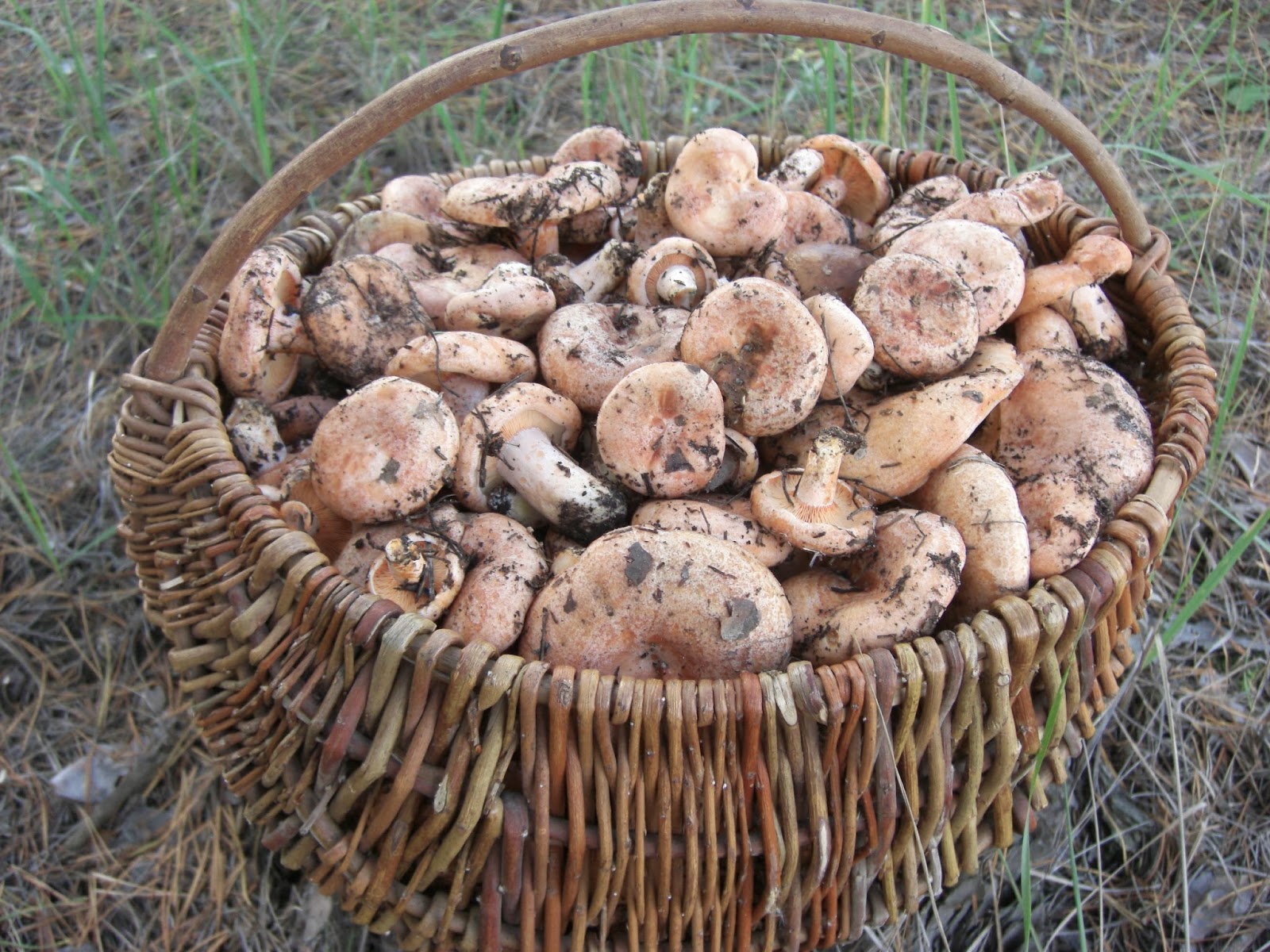
Yield of the day: left - bay boletes; top - the three ceps; top right - brown birch bolete; right - saffron milk caps;
 bottom - slippery jacks; centre - lots of chanterelles. A most productive trip!

Monday, 2 September 2013

Last day of summer

The hunting trip on Saturday was possibly the most rewarding and at the same time frustrating in the entire season.

Rewarding, because -

Two beautiful (almost) maggot-free specimens
The two ceps were right at the forest entrance, and together weighed about a kilogram. Now, after such a find any mushroom hunt is automatically declared a definite success. However, a hunt is not a hunt if it only lasts a few minutes, so the two beauties went in to the basket and the hunter pressed on.

After THREE HOURS of checking a hundred possible mushroom spots along a roughly 6 mile stretch of forest path, there was finally another find. Two amethyst deceivers. If you know what they are, you'll be laughing your sides off. Because, they are very nice edible mushrooms, no doubt about that, but it takes several hundred of them to fill a very small pot. Coincidentally, that's the numbers in which they normally grow, but I found TWO. Right, going on...

Using the convenient shortcut I found last time, which was then full with bay boletes, I only managed to spot these. And I can tell you, when I bother to take out my camera to snap non-edible mushrooms, things are not going well.

They looked so promising from a hundred feet away... disappoint
Sulphur tufts! Rather pretty and abundant, but bitter, inedible and even toxic according to some reference guides. The hunt was quite clearly over. Tired and frustrated, I planned the shortest route to the bus stop. However, two minutes later I stumbled on a faint path, at the entrance of which there were these:

Twins! (Actually, half-brothers)
Unusually, they were growing only a couple of feet apart, under the same birch tree. This hinted that the path beyond could hold more pleasant surprises, so on I went, even though it was only just going in the right direction.

After two more minutes, another most welcome find. A saffron milk cap! I almost gave up on them this season, but they were not gone, just a couple of weeks late.

Saffron milk cap. Long overdue for species highlight!
After that, many more saffron milk caps and brown birch boletes, as well as a few slippery jacks, and, for the finishing touch, a great chanterelle spot.

Chanterelle surprise!
In the end, the basket was almost full, so initial frustration was more than compensated by the last hour or so. The complete spoils are below. And what did I do with this haul? Come back tomorrow to find out!

Left: brown birch boletes (there really were a lot); top left: one bay bolete, badly eaten by slugs but still edible, next to it - an orange birch bolete; top: three ceps; top right: saffron milk caps, mostly maggot-ridden but still got enough flesh from them to be worthwhile; bottom right: slippery jacks; centre: chanterelles;
bottom left: a couple of wooly milk caps and cracked boletes, just for spore prints;
the two purple "worms" at right centre bottom are the two amethyst deceivers.