Showing posts with label wild food. Show all posts

Monday, 28 July 2014

A most successful hunt (and a toad)

End of July is the time when the forest starts displaying significant edible fungus diversity. I was counting on seeing many different kinds of mushrooms, but certainly not filling the basket. This is normally for August, the high mushroom season. But the recent warm weather, coupled with ample rain has urged fungi to fruit in greater numbers than usual.

The first encounter was a family of humble russulas -

A bit useless in the pot, but always an indication that better goods are nearby
Then some giant chanterelles hiding under heather -

Many more to come this trip!
 A sudden movement in the undergrowth -

Not a deer. Thank goodness for that!
Right next to it, a beautiful cep -

Good enough for a desktop background, not to mention my basket
A lone Amanita, probably rubescens (edible), but the first rule of mushroom hunter who wishes to die of natural causes is as follows: NEVER put an amanita into your basket.

Best left alone
A little bit further into the woods there was a large clearing, partly overgrown with heather, with lots and lots of chanterelles -

These, and about a thousand more nearby - all ripe for picking
These chanterelles were growing under birch trees, so the next encounter was not unexpected -

Brown birch bolete, in perfect condition
As well as the one after that -

Orange birch bolete. Highly unusual to see one in July.
Further on the forest path, a lurid bolete -

Not only beautiful, but also edible after a bit of boiling
And another perfect cep specimen -

Delightful!
Not far from it, some common deceivers. My basket was already full at that point (all those chanterelles!), and in any case they are hardly worth taking due to their small size and lack of taste. Still, they are certainly good enough for a photo -

Lovely colours!
And so the foraging trip ended. The final result is in the photo below. It took me the whole of the next day to process all those chanterelles, and my family has been complaining that the fungal component of their diet has become somewhat overwhelming. But they needn't suffer any more: I got a solution for that. More about it later!

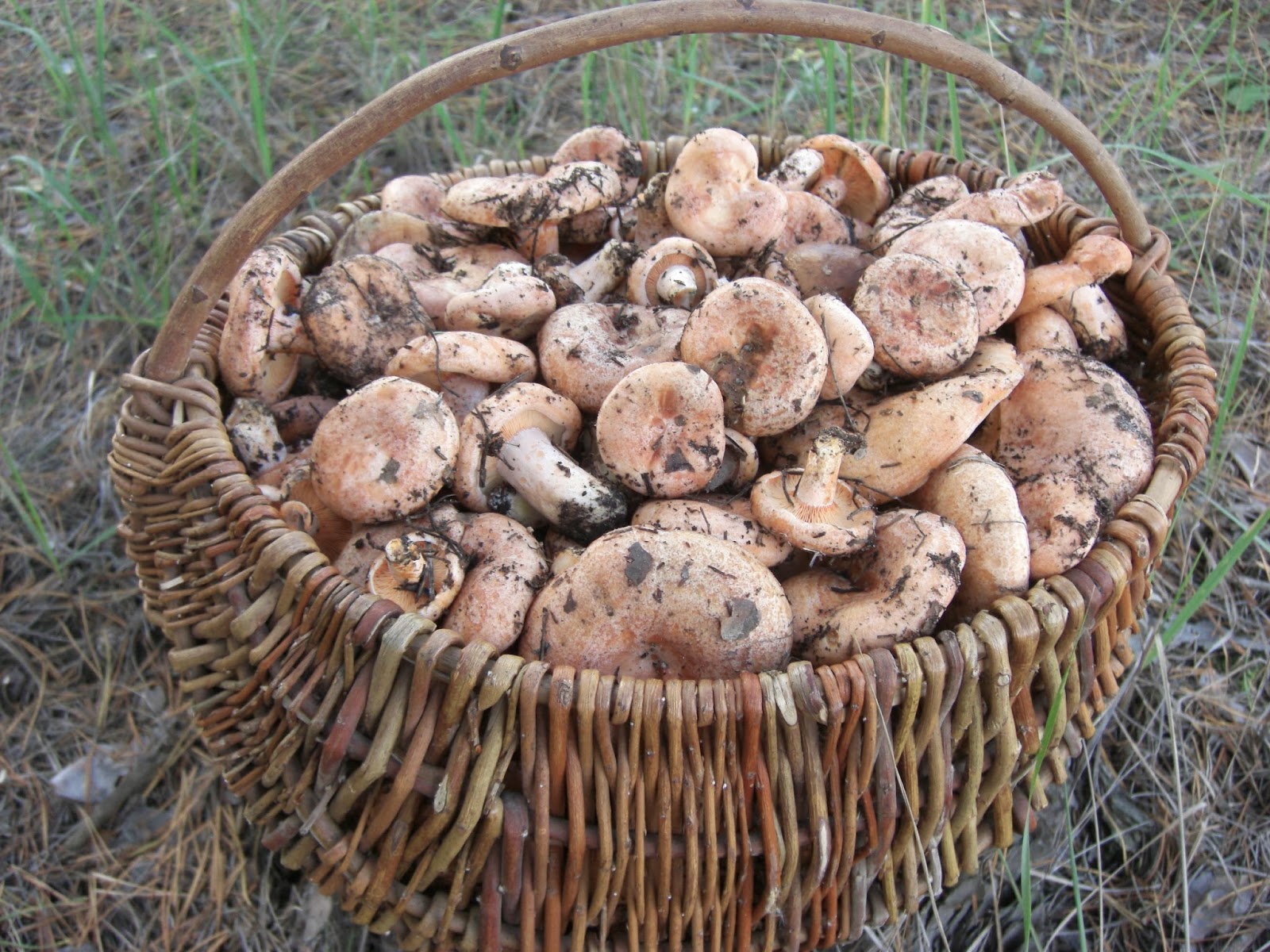
Clockwise from mid-left: slippery jack, bay bolete, four brown birch boletes, six ceps (and a cap), two saffron milk caps, orange birch bolete, lurid bolete and many, many, many chanterelles. A great haul, especially considering the time of year.

Tuesday, 22 July 2014

Some internet trolls

Do trolls like mushrooms? Anyway - breakfast is served!

Milky tea and chanterelle mushroom pie
After this, I had a most productive day in the forest - here is the teaser. Detailed report to follow!


Tuesday, 15 July 2014

Mostly frogs

I started off to the forest last Saturday hoping to get some first ceps, thinking that even though there hasn't been much rain lately, it should still be wet enough deep in the forest for some fungal goodness to emerge.

Just on the edge, I found this fungus -

Grey-spotted amanita
These fungi are apparently edible, but rules are rules: no amanitas in my basket! Ever. Its mere presence however was a most encouraging sign, meaning that my hopes for ceps were not unfounded.

But for the next hour or so, all I saw was this little critter, and hundreds and possibly thousands of its brothers and sisters, all hadly bigger than my little fingernail, hopping across paths and clearings to their promised ponds, or whatever counts as amphibian paradise:

So adorable!
So only much later, when I went right into the very heart of the forest, did I set my eyes on this magnificent sight -

What can I say - magnificent.
Not much to tell afterwards. There was a giant chanterelle -

Didn't know they could grow this huge
And then I got lost. Yes, that's right. In my home forest, which I know like the back of my palm. It was all because of logging. It's claimed to be "good forest management", but I really fail to see how it can be useful. Forests have been around for much longer than humans, and they somehow managed to manage themselves. Anyway, I mixed up paths because they no longer looked the same as they were last year, and took a wrong turn. After 15 minutes, I had my first doubts. This marshy patch looks familiar... Then even more doubts. This rabbit net looks just like the one I passed two hours ago... And then, finally - Those three rotten mushrooms on a log - oh dear, I'm about two miles away from the spot I thought I would be.

And that was it. The haul wasn't great, but the season hasn't really started yet, so I shouldn't complain. It has been raining more this week, so from here things can only get better!

Three ceps, one bay bolete, chanterelles, and wild raspberries and strawberries.

Monday, 7 July 2014

Spring archive - Part II

It has been very warm and dry recently, so much in fact that I had to start watering my garden plants. Not very typical Scottish weather!

There seemed to be little point to venture to the forest in these conditions, so I was sorting through some pictures, and found a couple in my mailbox, sent from Moscow region, which are worth sharing. Meet Gyromitra esculenta, the false morel:

In its natural habitat...

And in the basket, ready for processing
These mushrooms were subsequently parboiled and eaten. Now, if you look up reference on these, there would be warnings that these can be fatal when eaten raw, and even when properly cooked, may cause liver and kidney failure through the effects of cumulative poison.

They also, apparently, tasted more or less like slices of rubber.

Hmm, I'm not at all conservative with my food, but if I ever choose to risk serious poisoning, it would be for something that at least tastes good... Fugu fish, anyone?

Wednesday, 25 June 2014

Second chanterelle hunt

It has been fairly dry recently, so I didn't have high hopes for my foraging trip last weekend. But despite the lack of moisture, chanterelles were still growing, surprisingly more on sandy soil of the Tayport heath than deeper in the forest.

Deviating slightly from the path I took the previous week, I also found a semi-decayed lurid bolete, and a couple of overripe bay boletes. A forager's nightmare, this is. If only I took five steps to the left/right/off the path/took another turn (underline as required). Ah, well, you win some, you lose some.

And here are the trip results - all destined to go into a cream sauce a couple of days later:

About 500g here - already slightly dried out, but still good

Tuesday, 17 June 2014

First foray of 2014

This Saturday, as planned, I took to the forest in the hope of finding some mushrooms. I was expecting perhaps a few chanterelles, as it is still very early in the season, so only took a couple of small plastic containers with me.

Even before entering the forest, I knew that I should have taken more: the amount of fungal variety was much greater than you'd expect in mid-June. Firstly, puffballs:

Edible when young (like pictured)
Then, a beautiful red russula, complete with a slug -

Isn't it adorable how it is reaching out for food
And then finally, the stars of the show -

In significant numbers, too!
A nice looking fungus that I unfortunately I could not identify -

Rule No.1: if you can't positively identify it, don't take it, no matter how tempting it looks
Deeper in the forest, some slime moulds were munching their way trough moss and leaf litter -

It's yellow, but it's not a chanterelle
Overall, it was a much more successful trip than I expected. I even had to limit myself to taking the largest chanterelles so that I wouldn't run out of container space - very unusual at this time of year. One slight disappointment was that strawberries, which I expected to find in great abundance, were not quite ready yet. It has been fairly warm, but obviously not quite enough sunshine to let them mature properly. I'll just have to visit the patch in a week or so.

The grand total of the day:

That'll do Pig. That'll do :-)

Tuesday, 4 February 2014

Stash in the freezer

The ingredients
With all the recent frost and wind and fog, it seemed like spring was far far away, and mushroom season even further, so I was reluctant to open up my freezer. After all, what if it wasn't just a normal winter but the coming of a new ice age?..

However, with the arrival of snowdrops and aconites it became clear that we were safe from that catastrophe for now, and it was time to start eating into the stashes so that they are fully emptied before the new growth of ceps arrives.

I was really pleased that I was able to supplement my own ceps with an addition of wild mushrooms from a supermarket shelf, consisting of hedgehog fungus (bottom left) and grey chanterelle (bottom right). The three mushroom species, combined with some shallots and single cream, produced a great sauce for goose-fat roast potatoes we were having that evening. They all worked really hard: ceps provided flavour, grey chanterelles added colour, and hedgehog mushrooms were responsible for the firm, almost crunchy texture. White wine and cream took care of the rest!

And here they are, all together in a frying pan, just beginning to soften -

Ahh,, Beautiful!

Tuesday, 26 November 2013

Winter hunt

Winter is upon us, and I don't care what the calendar says because the temperatures in this part of the world have dropped below freezing already.

Naturally, mushrooms are not keen on the weather, and apart from an occasional bunch of ink caps, there is nothing to be seen among all the frost.

These days my hunts have to happen in mushroom isles of supermarkets. And I can tell you, the latest hasn't been bad at all! Behold - grey chanterelles:

Craterellus tubaeformis, all cleaned and ready to be cooked. Origin: South France, according to the label.
I have a feeling I'm missing out here in the frozen North...
Curiously, despite their name these fungi are only distantly related to the golden chanterelle, and in fact recent molecular phylogenetics studies have placed them in a different genus, Craterellus. Still, when it comes to putting these fungi into omelettes, they are just as good as their better-known cousin.

Sunday brunch: served!

Wednesday, 23 October 2013

Mushroom cities in the Pacific

Concept art for the floating city
I came across this article today, describing the sorry state of the Pacific ocean, which is gradually turning into a rubbish dump, and also a lifeless desert, due to extreme overfishing.

Why write about it in a mushroom blog? Because, according to the same article, fish and mushrooms are the only two wild foods that humans still consume regularly. There is literally nothing else! And, apparently, we are running out of fish, as well as ocean itself.

However, it pleases me that there are dreamers out there working to solve the garbage issue: Shimizu corporation who proposed a concept of a carbon-negative city, freely floating on equatorial ocean currents, recycling all those discarded plastics into building materials and energy.

These cities cannot yet be constructed with the current state of technology, but Shimizu's R&D people are very busy developing them. In 25 years, these will become a reality.

Come to think if it, the place seems to be a very nice retirement spot. And don't those towers look just like giant mushrooms?

Image credit:
Greenfloat city, Shimizu corporation

Wednesday, 9 October 2013

Mushroom festival!

My correspondent reports from St Petersburg, Russia:

"There was a mushroom festival here this weekend!"

Looking at the photos, I just wish I'd been there. Firstly, a spread of various mushrooms found in the Leningrad region (both edible and inedible). presented by St Petersburg mycological society:

It's curious how exactly the same mushrooms and mosses grow so far away from Scotland, but there you are
Some of the mushrooms were for sale, too. Unfortunately, the only ones sold fresh were chanterelles (my friend was greatly disappointed because she was much hoping for saffron milk caps to which I managed to get her addicted in Scotland), but the selection of salted and marinated ones was most impressive.

Catering for every taste
And finally, the centrepiece of the festival: a massive vat of mushroom soup. The charge was £3 per bowl, but apparently it was worth it. They really cooked it in that huge thing! What can I say. Russians. Awesome.

The mushrooms were collected by company "Matreco" in Komi region. According to the sign, the cooks were from
"Russian college of traditional culture". The soup must have been amazing!

Wednesday, 2 October 2013

Brown roll rim

Paxillus involutus
Many people are scared of poisonous fungi such as death caps, or destroying angels, or deadly web caps, which kill you quickly, painfully, and reliably. Fungal poisoning though can be more subtle than that. Meet the brown roll rim, the fungus that could kill you after you'd eaten it one hundred times with no ill effects. That one last time, it causes an autoimmune reaction in its victims that destroys red blood cells, ultimately causing kidney failure. It is not a cumulative poison, as some sources suggest. The exact reasons why some, but not all, instances of brown roll rim consumption result in serious illness, are not known.

Because deaths by brown roll rims are so rare, the toxicity of this mushroom has not been recognised until recently. Indeed, in parts of Central and Eastern Europe it is still consumed, sometimes in great quantities, as evidenced by the photo below.

Looks great, but these are not for me
I have to admit that this species highlights a serious issue with wild food generally: in truth, you never can have a total guarantee that the stuff you bring in from the forest is safe. There are no biological, chemical or radiological controls to reassure you, unlike in big supermarkets (although, the recent horsemeat burger scandal shows that even their procedures are not 100% reliable).

Fortunately, with properly identified edible mushrooms the risk is minimal. But brown roll rims? No matter how inviting that pot of cooked mushrooms looks, I'm giving it a miss.

Image credits:
Paxillus involutus
Cooked brown roll rim (personal communication)

Tuesday, 1 October 2013

Meanwhile, in the East...

Mushroom season here in Scotland is ending, but this is clearly not the case in other places. Consider this foraging report I got from a friend in Germany:

Ceps, lurid boletes and a few bay boletes - very nice haul!
But it is the Ukrainian report that makes me truly jealous. Saffron milk caps. SAFFRON MILK CAPS!!

Maybe I'm living in a wrong country...

Monday, 30 September 2013

At the end of the season

I had a wonderful time in the forest this Sunday. The mushrooming season is clearly coming to a close, but I must confess that despite the scarcity of fungi, these last trips I find the most pleasurable of all. Mostly, because of the declining number of blood-sucking insects. A good repellent does away with 99% of the problem, but the remaining 1% can really hurt. Another reason, perhaps unexpectedly, is that there are fewer mushrooms.

Yes, that's right! When there are many mushrooms, they are harder to carry home, and also collecting them is a routine and not an adventure that it should be. Early August, every mushroom is just a +1 for the freezer. Late September, each and every one is an achievement and testimony to a mushroom hunter's skill.

And here was the first set - Lycoperdon perlatum:

Not that spectacular, perhaps, but edible and abundant
In fact, I have never cooked these before, so there is the challenge for tomorrow. After that, one of the forest staples:

Brown birch bolete - not the most amazing mushroom in existence, but every little helps!
Not long after - a whole family of slippery jacks:

Now, there is enough for supper in the basket!
Next, a perfect specimen of a fly agaric. Left it alone, of course, but kept my eyes peeled, because where there are fly agarics, there would be ceps, too.

If only it were edible... but so beautiful!
And then, right next to it - I couldn't believe my eyes! So late in the season, but there is was:

A cep! Touched by mould a bit, but still edible.
And here is the complete crop of the day. Just enough for tea!

Pearly puffballs (top left, brown birch boletes (centre), bay bolete (top right), chanterelles (bottom right),
cep (centre left), and slippery jacks all over the place.

Thursday, 26 September 2013

Which kind of chanterelle?

Early chanterelles
A recent news article raises an interesting issue, which is that many mushrooms that we normally think of as a single species, are not. Kathryn Perez and Matthew Foltz proved by DNA analysis that golden chanterelles growing in Hixon Forest in Wisconsin are in fact three different species, and not merely colour variants.

Chanterelles are mushrooms that I collect every foraging trip, and one thing I have been puzzled about is how long their fruiting season is. It starts in mid-June and continues until mid-October, and sometimes even later if there is no ground frost. No other fungus in the local forest covers even half of that span.


Over these four months, it does not fruit everywhere though, but rather there are "early" and "late" spots, and the mushrooms from these do have a difference in appearance. Early chanterelles are typically smaller and lighter in colour, with cream stems and wavy false gills. Later in the year, I see only yolk-coloured, larger fungi.

Late chanterelles
Previously, I thought that the difference in shape and colour is explained by the variance in conditions in which these chanterelles grow, temperature- and humidity-wise, but I realise now that their emergence in different spots probably does mean that they are distinct species.

Not sure about one thing though - the article says, "Documenting the new species, their locations, and physical differences including taste, will be of interest to the culinary industry". I am no mycologist, but I have cooked a lot of chanterelles in my life. You can trust me on this: these mushrooms might look different, but THEY ALL TASTE THE SAME!

Wednesday, 25 September 2013

Beef stroganoff with wild mushrooms

Ingredients
With the unique crop I brought home last Sunday, I thought I needed to do something special, and taking upon the challenge of cooking an edible beef stroganoff seemed just right.

Ingredients were as follows:

- 300g rump steak, cut in thin strips
- flour, to coat the above
- 100g shallots
- a few cloves of garlic
- large glass of white wine
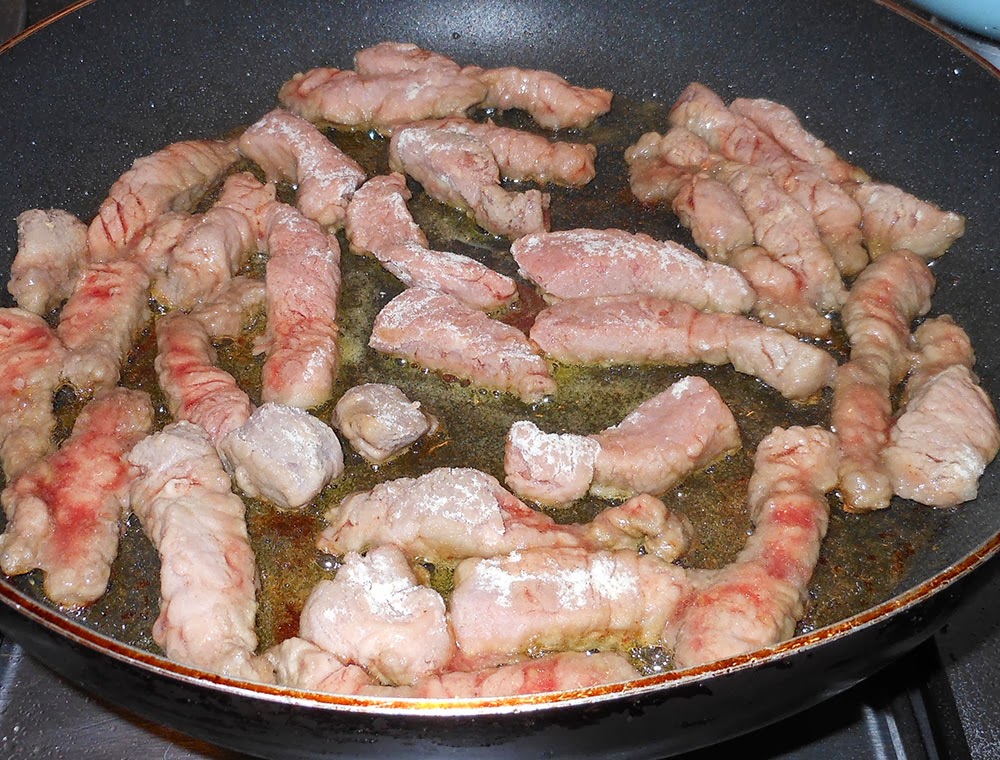
The right way to fry meat
- 100g single cream
- sage, bay leaf, peppercorns
- 1 cube of porcini stock (but vegetable stock would do just fine)
- herbs, to garnish

Now, am I missing something? Oh, yes, and of course:

about 300g of finest wild mushrooms as found in Scottish forests. I have used ceps, slippery jacks, one brown birch bolete and a few hundred amethyst deceivers. But if you can't get those, plain chestnut mushrooms will do just fine.

The main ingredient
Process:

Coat the meat in flour, and throw on pre-heated frying pan. Fry for a few minutes on high heat, turning once. The meat must brown slightly, but must NOT be cooked through. This is very important as otherwise it'll stay tough, no matter how long it is stewed afterwards. In another pan, fry the halved shallots, sliced garlic and sage leaves, on medium heat. Once the meat has browned, add it to the shallots. Make sure you scrape all the delicious crispy bits from the pan into the pot. That's what will make the stroganoff taste so good!


Last stage, 30 minutes before end
Turn the heat up and pour in the wine. Dissolve the stock cube in 0.5l of boiling water and pour it all in. Cover the pot with heavy lid and simmer on medium low heat.

Meanwhile, clean and wash the mushrooms. Add them to the pot after 1 hour, and cook for a further 30 minutes. Add the cream, bring to the boil, and you are done!

Serve with chips or roast potatoes and fresh herbs. Bon appetit!

Note how the tiny laccarias keep their purple colour in the stew. These little beauties are amazing!