Showing posts with label identification. Show all posts

Thursday, 12 June 2014

Logs have ears!

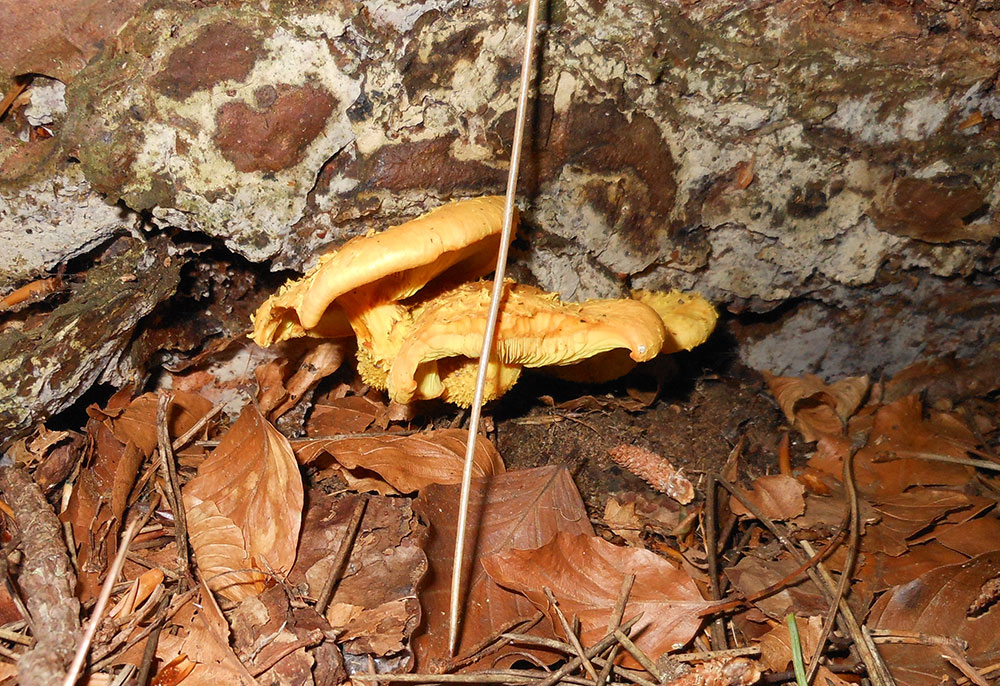
This was one of unexpected winter discoveries that I made in small wooded area that I cross every day on my way to work. One day in late February a dead log sprouted brown-pinkish growths: Judah's Ears!

Temptation to forage them for food was powerful, but knowing how well-loved that particular log is by passing dogs, I managed to abstain. Also, I already have a pack of these wonderful fungi, in compact dried form, in my cupboard. So, just a photo -

Stunning!

Thursday, 31 October 2013

Mushrooms in late autumn

It has been a while since I posted some proper fungi spotting photos. Edible mushroom season is long gone, but quite a few tenacious fungi are still getting their heads above ground. Like this one, for instance:

Common cavalier, growing in leaf litter in mixed woodland
A couple of minutes later, while walking along a river bank under some very old pine trees, I found a big group of cavalier's relatives.

Clouded funnels. There were about a hundred of them on that spot!
Moving on, I found the only truly non-edible mushroom for today, growing on a rotting stump leaning over a stream. That's right, the two species above are edible, although not recommended due to combination of lack of taste and texture, possibility of confusion with similar poisonous species and occasional individual gastric reactions even if correctly identified.

A splash of colour - a welcome change from previous specimens. Brick tuft.
Beautiful, but not edible even when this young
Finally, right next to my office (did I mention that I took the pictures on my way to work today?), a company of ink caps, past their prime, but still looking good enough for a photo.

Remember: it's either eating these, or drinking alcohol. DO NOT combine!
All in all, not a bad photo collection for the last day of October! It has been very mild recently, with lots of rain, hence the relative fungal abundance. I'm sure I'll be back soon with more photos. Meanwhile, stay warm, and don't eat any funny mushrooms!

Friday, 11 October 2013

Mushroom gangs

Perhaps not very
appropriate for an article
about edible fungi!
There has been a couple of near identical articles recently in The Telegraph and The Daily Mail about unscrupulous mushroom pickers (coming "mostly from Eastern Europe" of course, where else!) going around fields and forests in Hampshire and stripping "huge tracts of land" bare of fungi, getting huge profits from this year's bumper harvest.

The Daily Mail has a photo of several baby porcini illustrating their article, whereas The Telegraph proudly displays a very nice image of panther caps, which are both very toxic AND psychoactive. Ironically, the latter article contains urgent advice to its readers to arm themselves with guide books, and never ever pick fungi that cannot be identified with absolute certainty. Perhaps they should follow their own advice and start with their photo editor?..

Image credit:
Amanita pantherina

Wednesday, 4 September 2013

Orange!

Got to love them
Saffron milk caps are one of my long-time favourites. Their Latin name is most appropriate: Lactarius deliciosus. Some mushroom hunters believe that there is no finer mushroom on this planet, and I tend to agree. The combination of strong taste, firm texture and vivid orange colour of both raw and cooked mushrooms is second to none.

Ceps, the universally recognised mushroom royalty, have just one advantage over saffron milk caps: the former are equally good fresh, frozen and dried, and keep in the fridge for at least a week, whereas the latter start turning into greenish goo after just a few hours. The only possibility of preservation is to pickle them. There are some fans of this method, but to me the result looks (and tastes!) like brown slugs.

A word of warning: there is one lookalike poisonous species in temperate forests. Its distinction from the true saffron milk cap is that it grows under birch and has white milky sap (the original's is bright orange) and wooly edge under its cap.

Russian field guides maintain that wooly milk cap is edible if pickled, but even they admit that if one makes its way into a frying pan, the result would be a massive culinary disaster.

The two mushroom species do look very similar though, and this must be the reason why all saffron milk caps in Scottish forests are mine. As long as I get to them before the maggots...

Image credit:
Lactarius deliciosus

Thursday, 22 August 2013

Eating strange mushrooms

Can you tell the difference between
these two? If not, then experimenting
with strange mushrooms is not for you.
About once a year, I eat a new kind of mushroom, both to increase the range of collected edible species, and out of curiosity, as all mushrooms have different taste and texture, and therefore can be used in varying recipes.

But what gives me confidence to eat strange mushrooms despite the constant barrage of news stories of people getting poisoned? Here is a list of handy tips:

1) Always be sure of the identity of mushroom you are planning to consume
2) Know the List of deadly fungi by heart and never eat anything that resembles these mushrooms
3) Particularly, never eat Amanitas - these account for 95% of all fungi-related deaths
4) Always make sure it's properly cooked
5) Never eat more than a small quantity the first time
6) Always keep a sample of your mushroom in the fridge, in case you do make a mistake and the toxin needs to be identified.

Observing these guidelines minimises the risk but there are still no absolute certainties. The rules make it highly unlikely that you'll get seriously ill or die from such experiments, but gastric upsets of varying severity are a very real possibility. The guarantee, ultimately, is as good as your identification skill. For instance, the photo above is an extreme case of very similar mushrooms only differing in one small detail: one of them has fine red dots on the stem right under the cap, while the other has a netted pattern. I doubt that many people can tell them apart, and this is the real reason why collecting wild fungi for the pot is never going to be a very popular pastime.

Image credits:
Boletus luridiformis
Boletus pulcherrimus

Thursday, 15 August 2013

Deadly webcaps, again

Deadly webcaps: GILLS
This has been on the news, and therefore it must be true.

An "experienced forager", who "had been collecting mushrooms for many years" fed deadly webcaps that he mistook for ceps to himself, his wife, brother-in-law and brother-in-law's wife. Result: all four eaters in hospital for weeks, with varying degrees of kidney failure, one of them needing a transplant. Luckily, the children, who were also invited to sample the poison, wouldn't have any, otherwise they would have almost certainly died.

Deadly webcaps. Mistaken for ceps. You've got to be kidding me.

Ceps: TUBES
*HEADDESK*

In this post I have already wondered how a deadly webcap could be possibly mistaken for a chanterelle. Now I wonder no more - at least, both mushrooms are of similar size, and they both have gills. After all, I've observed small children to confuse dogs with cows, so why not. But ceps and deadly webcaps? It's like mistaking a chicken for a pig! Now, if you'll excuse me, I'll just go into a quiet corner and cry. Today the world's stupidity is a bit too much for me.

Image credits:
Deadly webcap, Cortinarius rubellus
Ceps, Boletus edulis

Wednesday, 14 August 2013

Scarlet and scary

Boletus luridiformis,
a perfect specimen
John Wright, the author of the River Cottage Handbook on Mushrooms, says thus: "Do not worry about the Leccinum's tendency to go various shades of greens and pinks and blacks when cut - they are just trying to frighten you".

Now, I have eaten a good number of orange and brown birch boletes (both of which are Leccinum species), but when it comes to this relative of theirs, the scarletina bolete, Boletus luridiformis, it took me several years to get together the courage to put it into my cooking pot.

The reason is, it's indeed lurid: velvety dark reddish-brown cap sits on top of a densely scarlet-dotted stem, the cap underside is dark-red, and its bright yellow flesh turns a vivid blue when cut. Everything in this mushroom screams: DO NOT EAT ME!

There is a method
to my apparent madness...
(if you don't have one,
NEVER eat strange mushrooms!)
However, the abovementioned reference book says that it is safe to eat as long as it is thoroughly cooked. So the scream apparently just means, "don't eat me raw". I'm fine with that!

The method for cooking I chose, just to be on the safe side, was to slice one cap, boil the pieces in plenty of water for 15 minutes, discard the water, and then fry the fungus in some butter with salt. The result was pleasantly firm, mushroomy and nutty. I only ate a little bit at first, as this fungus is known to cause gastric upsets in some people, but if all is well in the next 24 hours, it would mean that I'm one of the lucky majority who are unaffected, and then there will be yet another mushroom that I'll be able to harvest!

Image credit:
Boletus luridiformis aka Boletus erythropus

Tuesday, 13 August 2013

Lots of ceps!

However, let me not get ahead of myself.

The trip started with finding a beautiful specimen of edible Amanita rubescens (or possibly deadly poisonous Amanita pantherina). I left it alone as the gamble wasn't worth it, but there was immediately a good feeling about the trip, as the emergence of this fungus usually means that ceps are in season.

Delicious or deadly? If unsure, leave it be

Right next to it, some small boletes - also a sign of bigger things to come. I took a few for spore prints and positive ID, although I very much doubt they offer much in terms of edibility.

Edible, possibly - but why bother?
And then, some beautiful false chanterelles. Contrary to popular belief, they are not poisonous, but merely inedible. I still love them dearly, because, like the two encounters above, they are a definite indicator that deeper in the forest, something big awaits.

False chanterelle - note the strictly bifurcating true gills distinguishing it from its true namesake
Some wild sorrel - I picked a bunch to put into my salad.

Tender leaves with delicate sour taste, excellent in salads with pickles
And then, finally, the big ones. Meet Boletus luridiformis - hideous on the outside, delicious on the inside (or so most reference books are telling me anyway). I have never seen or picked these before, and the plan is to cook them tomorrow. The largest cap is currently resting over a white paper napkin for a spore print, but I am absolutely positive of its identification already: its appearance is unmistakable. Provided I survive sampling the dish (don't see why not), I'll post its species highlight tomorrow, as it is a most remarkable fungus.

Beautiful and deadly... no, just beautiful (and its seven brothers nearby, too)
Turning the corner... and words fail me. Spirits of the forest have smiled on me (even though, as everybody knows, they don't exist). Just LOOK at the size of these fungi!

...! ...! ...!
Here is the final image, after which I'll leave you in peace: the total haul of the day. This is the reason why mushroom hunters love their pursuit so much: you never know what you are going to get. One week it's a handful of chanterelles, and then the next - this. 3 kilograms of finest mushrooms! Today, life is good!

Mostly ceps, but also lurid boletes, larch boletes, chanterelles and false saffron milk caps

Friday, 9 August 2013

Edible mushroom identification with Peter Jordan

Videos as these, in my opinion, do not help in identifying edible mushrooms. Indeed, it is rather dangerous to go wild mushroom foraging armed with just the information they give. Good printed field guides and reference books are much more useful in this respect.

So why am I posting this? Because it gives me great pleasure to see someone pick edible mushrooms and put them into his basket.

Enjoy the video, and see you next week, for more mushroom stories.

Wednesday, 7 August 2013

Beatrix Potter, a Victorian naturalist

Souvenirs from the Armitt Museum
My recent visit to Lake District was centred mostly around nature trails and dogspotting, as well as doing weird things such as scaring goldfish living in a telephone box next to a pub in Torver, and giving a traffic cone a tour of the Northern lakes (the latter was my companion's idea, and I swear we were not eating any funny mushrooms... although, after having written this down, I am not entirely sure). However, there was one cultural experience, and that was a visit to the Armitt Museum in Ambleside. It would have been just another local history museum but for one remarkable woman who lived in the area for for most of her life bequeathed to it her archives: Beatrix Potter.

Now, everyone knows that she is a highly acclaimed children's author, the writer who brought to us the tales of Peter Rabbit and his friends, in which charming and simple text is accompanied by beautiful illustrations. In my opinion, these illustrations are a major factor in the success of her books, as it is thanks to them that the stories and characters in them are really brought to life.

Illustration to "The Tale of Squirrel
Nutkin" (spot the mushrooms!)
What is not so well known is that before writing her first Peter Rabbit story she was a passionate amateur mycologist, and that her legacy includes hundreds of fungi drawings, so detailed and accurate that after more than 100 years they are still easily identifiable. She was also the first person to prove that fungi propagated by spores and managed to germinate them (among her drawings there are her observations of this process through a microscope). She also was the first (in Britain) to suggest that fungi and algae comprising lichens are symbiotic rather than parasitic. Altogether remarkable! She even submitted a paper to the Linnean Society on the subject of spore germination, but it was never published, almost certainly due to some power play of the people in charge. And, almost certainly, because she was a woman. Arrgh, Victorians!

It must have been a great disappointment for her, but there is something we have to thank those eggheads. I am sure that their refusal to publish her paper spurred her to try her hand at a different kind of publication, and a good children's book is much better than any scientific paper, especially one that actually has such significant educational value: her illustrations of plants and English countryside are extremely accurate, even though her description of animal habits is certainly not! I am deeply saddened though that one thing is missing from them: fungi. Except for one illustration to "The Tale of Squirrel Nutkin", all she ever drew for Peter Rabbit was plants. Perhaps that experience at the Linnean cut deeper than her biographers thought, as after it she gradually stopped producing fungi drawings altogether.

Monday, 5 August 2013

Things are picking up

Don't get me wrong, it wasn't a very successful trip by any standards, especially taking into account it's early August - this time in previous years, ceps and other edible boletes used to ambush me left and right and middle. As it happens, after 5 hours' walk I only brought home a handful of chanterelles. But, something is definitely changing in the forest - see for yourself.

Firstly, I found these white fungi, next to an old beech, growing among dead wood. Never seen them before! The closest match in my reference book is Clitopilus scyphoides, but it's not really funnel-shaped, so must be some lookalike.


Next, came a couple of specimens of flaming scalycap growing from underneath a rotting conifer trunk.


Then, some little brown mushrooms, cucumber tuft or something very similar.


After that, some even littler white mushrooms, at whose ID I cannot even give a stab:


And, finally - something edible:


Last but not least, in the darkest and wettest part of the woods, a grey spotted amanita. Its edibility is suspect, and in any case it shouldn't be eaten because of the possibility of confusion with deadly poisonous Amanita phalloides and Amanita pantherina. However, its appearance suggests that the conditions are finally right for larger mushrooms to appear. It probably means that next week I'll finally bring home a cep!


And, just to wrap up, the result of the day:


Small in number, but big and juicy, and I have plans for them which involve rice and wholegrain mustard.

Stay safe, don't eat any strange mushrooms, and I'll see you tomorrow for the recipe!

Monday, 22 July 2013

No rain - but not for long

The weather forecast says that the dry heatwave is coming to an end, and this is great news for all mushroom hunters. This weekend, while waiting for the life-giving moisture to fall from the sky, I checked out the local woodland, in the mad hope that somehow, somewhere, fungal life will manifest itself.

Good news: I found some mushrooms. Bad news: they were neither edible nor easily recognisable. They were growing on a living tree about 3m above the ground  - probably some sort of polypore. Really big ones: the largest must have been 30cm or so across.

1.1 kg of wild strawberries
I do apologise for a bad picture of unexciting mushrooms - this is no good for a Monday foraging report, but hey, don't blame me. Blame Scottish weather. It is used to it anyway.

By way of tiny compensation for this disappointment, here is an image of last week's complete strawberry crop - this time I managed to snap a shot before it was gobbled up.

And now, since woodland has not been kind enough to provide, I'm off to the shops for some ingredients for tomorrow's recipe. See you soon!

Wednesday, 17 July 2013

Trees and stumps

What is it?
Our spell of (proper) summer continues, and the ground is already getting parched. So much in fact that even the strawberries are getting unhappy. A couple of my minions (other people usually call them "family members") went to the forest yesterday and brought back 1.1kg of berries, and that's probably the last of them this summer.

The only place where there's anything of interest is the trees and stumps, and I came across a rather fine fungal specimen today. As you can see from the photograph, it is quite big, the cap about 15cm across, and its thin stem at least as tall, growing from a dead tree stump. It looks a bit like some kind of entoloma, but the stipe is too thin and their caps, as far as I know, are never convex. A mystery! If it's still there this evening I'll take it home to make a spore print, and then perhaps I'll be able to identify at least its genus.

UPD: The spore print turned out to be white, so I have to conclude that it is some kind of toughshank.

Wednesday, 3 July 2013

Some shades of grey

Grey heron
Monday's visit to the forest was marked not just by a decent crop of chanterelles, but also a few encounters with local wildlife. There are several shallow lakes (we call them "lochs" in Scotland) scattered around the forest, which are home to many birds, such as mallards, greylag geese, mute swans, coots, moorhens and many others. One particular resident of the loch decided it was happy to pose for a portrait, and here is the result. Grey herons are very common but also quite shy, and it is unusual to get a photo of one so close.

Grey russula
And what about mushrooms? The only sighting, apart from the edible fungi, was a grey russula, making a lonely appearance in the middle of a pine wood. But was it a Russula grisea? A pale-coloured cyanoxantha? Or, perhaps an amoenolens? Although, the latter is unlikely as it did not have a fishy smell. In short, yet another dose of russula-related frustration: we will never know the answer.

Wednesday, 26 June 2013

Russulas - beautiful and deceitful

A typical russula
My relationship with genus Russula has never been an easy one. There are some things that are so great about them: they are among the first mushrooms to appear in the forest and among the last to finish fruiting, they are abundant, they are colourful and good-looking. Some of these fungi are quite delicious, too, and this is where I have an issue with them.

Same mushroom from below
It is actually very easy to identify a mushroom as some kind of russula: the form of the cap, stem and gills are all very distinctive. However, distinguishing between the 750 or so species within the genus is a nightmare. After carefully considering form, colour, ecology and spore print, you are typically left with 3 or 4 possibilities, one of which would be edible, one toxic, and the rest inedible or not worthwhile. Arrgh!! I don't want to take any chances!

One could argue that identification in the case of russulas is less critical than for amanitas. Indeed, no one has ever died of consuming a russula, but there are still many among them that are bitter or have unpleasant taste, or worse. Take Russula emetica for instance: eat one of those, and over the next few hours you will be stuck in the loo, with both ends of your digestive tract adversely affected. Not fatal, but extremely unpleasant! The fact that russulas appear so early in the year makes this dilemma even more excruciating. It is easy to give a miss to mushrooms with uncertain ID when your basket is already getting full, but it's a different story when all you manage to collect is a couple of handfuls.

Take the fungus in the photos above, for instance. Is it Russula decolorans? fragilis? or an unusually coloured olivacea? There is no way to know for sure, so with much regret, I put this beautiful specimen back where I found it, and go back home with just the chanterelles. Because I could never mistake them for anything else.

Wednesday, 12 June 2013

The case of fly agaric

Belle of the woods
It's Wednesday, and therefore time for a new species highlight. Originally, I was planning to alternate the feature between edible and inedible/toxic mushrooms. Last week it was chanterelles, so I thought, I need something equally well-known to introduce the poisonous varieties. And what fungus can do better than the iconic fly agaric, Amanita muscaria?

And then, I got on the web to check my facts, and got confused. Whereas all mushroom identification guides I've come across unanimously list this fungus as both poisonous and hallucinogenic, a quick web search threw up several links where people were consuming fly agarics as food.

The trick, apparently, lies in boiling them for at least 15 minutes in lots of water. This removes both the toxin (muscarine) and the hallucinogens (ibotenic acid and muscimol). Afterwards, the mushroom can be fried in butter and has an "unusual nutty taste" which "makes you wish for more".

Interesting taste is not the only argument of the proponents for its food consumption. They point out that the fly agaric is available in large quantities, that there are lots of other foods we eat that are toxic raw (red kidney beans for instance) and that it is almost impossible to misidentify. All true! But then, given the large variation in toxicity, boiling may not be sufficient to detoxify some strains; in addition, they need to be kept separately from other mushrooms to avoid contamination with the spores, which are also toxic; and finally, collecting these fungi can be illegal. You fancy explaining to your local policeman that the 3 kilos of red-capped mushrooms in your basket are for family dinner? Me neither.

Giant fly agarics in Minecraft
So, all things considered, I'd give fly agarics a wide berth, and only collect them as photos. And in Minecraft. Red mushrooms with white dots are safe to eat there and are farmed for both food and building material. Could it be where Ecovative got their ideas from?..

Links to some of the articles:
On the subject of fly agarics (this one is about what can happen if you do not cook them properly)

Image credit: 

Monday, 10 June 2013

Mushroom season: on the approach

Look! They now grow in groups
This weekend I slapped on some factor 30 sunscreen (yes, such days do happen in Scotland - that's global warming for you) and took off to the woods with the minimum hunting gear: just a knife and a plastic container. There hasn't been much rain recently, so I figured out that the loot, if any, was likely to be found in the deepest and wettest part of the forest.

Still no chanterelles! However, things are definitely starting to look up: there was a spread of little brown toadstools pretty much everywhere under the spruce, and that means that the nice tasty fungi will follow before long.

So desperate was my longing for mushrooms that I took these two toadstools home and took a spore print, in the hope of making an identification. The spore print was rusty brown, which confirmed beyond any reasonable doubt that the specimen was a Little Brown Mushroom, Almost Certainly Not Safe To Eat. I knew that already of course, but it's always good to be sure.

So, in the end I had to go for Plan B, the local supermarket. I wish I had a Plan C, because while I was snapping pictures of the toadstools in the forest, the shop ran out chanterelles, which were this week's wild mushroom on offer. What? Competitors on my spot! Arrgh. They must have been reading this blog. I had to console myself with oyster mushrooms and shiitakes. OK, it could have been worse: they are perfect for tempura, and cooking report will follow tomorrow.

Wednesday, 5 June 2013

Concerning chanterelles

While I have yet to see this year's first chanterelles, I thought I should present them properly, since in the coming months I am planning to devote quite a few posts to their collection and cooking.

Golden chanterelles, C. cibarius
Golden chanterelle (Cantharellus cibarius) is one of the easiest fungi to identify: its yolky colour and absence of true gills clearly distinguish it from similar species such as false chanterelle (Hygrophoropsis aurantiaca) and jack-o-lantern (Omphalotus olearius). Even if a mistake is made, false chanterelle is not poisonous but merely inedible, and jack-o-lantern's effects are not fatal, although extremely unpleasant. Also, the latter is very rare in the UK and as far as I am aware non-existent in Scotland. There was a news report a few years ago that someone died from eating deadly webcaps, Cortinarius rubellus, thinking that they were chanterelles, but come on, it is like mixing up white button mushrooms with shiitakes. If your attention to detail is that bad, foraging for wild mushrooms should not be on your list of possible weekend activities in the first place.

Deadly webcaps - not at all alike
Chanterelles are to be found in Scottish forests from May to October, they usually grow in large groups, so just one good spot is enough to fill a basket. I find that it is best not to clean them if they are not to be used immediately, but just shake off the slugs and put the mushrooms into the fridge in plastic containers, to be washed and cleaned right before cooking. If picked on a dry day, they will keep for a week or more. Unfortunately, this species does not lend itself well to preservation, as drying them ruins the texture, and freezing makes larger specimens bitter. It's best to cook them fresh.

As for their culinary use, chanterelles do great in sauces, stews and even salads. However, in my opinion, their unique flavour is at its best when they are combined with beaten eggs. Even a handful of them in an omelette makes for an extraordinary dish, and if you have enough for a quiche, this will take you straight to heaven. Metaphorically. Chanterelles are safe to eat even raw.

Despite many attempts at cultivation, chanterelles have so far evaded domestication. In 1997 an article in Nature, "Successful cultivation of the golden chanterelle" described a process by which fruitbodies were obtained from under 16-month old pine seedlings, suddenly giving hope to all chanterelle fans. Sadly, it was just a lucky fluke because the authors in the end failed to create conditions for consistent appearance of fruitbodies, and all chanterelles that are sold in grocery shops and supermarkets these days are collected in the wild.

Image credits:
Cantharellus cibarius

Cortinarius rubellus

Monday, 3 June 2013

Mushroom quest 2013: continued

Not for eating! Pretty display though.
My Sunday trip to woodland brought yet another disappointment. No matter how hard I looked, no fungi presented themselves even to be photographed, let alone to be collected and eaten. Obviously, the recent warmth has not been enough. I've seen a report on the news that flowering season for bluebells was 4-5 weeks late this year. Does this mean that I'd have to wait for the first chanterelles till the end of June? I hope not!

Scotch bonnets! Oh, wait...
Despite my walk in the woods being a total flop (the magnificent display of wild flowers carpeting the forest floor doesn't count, does it?), I did get a couple of consolation prizes on my way home. Walking down the street I spotted two flower containers with features that were clearly not intended in the original planting design. At first I thought that my first find was a group of St George's mushrooms, but on closer inspection they turned out to be, most likely, some species of Inocybe. The second one at a first glance looked like Scotch bonnets (there was even dead wood present!), but the gills were all wrong, so I reluctantly had to identify them as LBMs*. Trip result: basket=0, camera=2. An improvement on the first attempt, but still not good enough.

Luckily, the supermarket was not too far away, so I consoled myself with buying a pack of exotic mushrooms, consisting of yellow and pink oyster mushrooms and shimeji. Firm texture, strong flavour... I think I know the perfect recipe to make these stand out. So it is decided: tomorrow - cooking report!
===================
* Little Brown Mushrooms

Tuesday, 14 May 2013

Identification and rules of thumb

The key point of the video that inspired the previous post was, "If you don't know what it is, don't eat it".

But how do you actually identify your mushroom, and are there any reliable indicators that the mushroom in question is edible?

Putting a name to a mushroom can be a challenging task, because the fruitbodies that we eat are not the organism itself but merely its reproductive organs. So what we are trying to do here is essentially the same as attempting to identify a mammal by the shape of its... erm... lungs or kidneys. How do we do that?

1. Fungus appearance. A good mushroom guide will list perhaps 30 possible characteristics that need to be looked at, such as cap size and colouring, shape and position of gills, stipe markings, etc. etc.   If you have all day, great, because you'll need it. Don't forget a dictionary. Half of the words won't make sense at first reading.

2. Ecology. Where is the fungus found? As mentioned in the previous post, there are many lookalikes that can fool even an experienced forager if put next to each other, but can still be easily told apart since they form relationships with different trees. For instance, the poisonous woolly milk cap from the previous post is associated with birch, while the delicious saffron milk cap grows under pine.

3. Spores. It is impossible to do a spore print in the field, but completing it greatly improves the chances for correct identification. Just put the spore-bearing part of your fungus over two pieces paper, white and coloured, and wait for 24 hours. If you want to be really thorough, you can also look at the spores under a good microscope, but this will probably take you over the line beyond which a hobby becomes obsession. Keep it healthy. Breathe.

Remember me?
But what if you don't wish to remember all of these details, and do not want to wait for spore prints? Suppose, you have a can of soup to improve NOW! Any, hmm, rules of thumb?

For instance, is the mushroom safe to eat if its cap peels? Or if you find it complete with a slug, happily munching on its stipe? In fact, deathcaps can be eaten by slugs and insects (they are unaffected by the toxins) and have a peelable cap. These are the two most dangerous misconceptions of which I am aware, but all other "edible mushroom indicators" I've come across are at best useless. So, are we definitely stuck with making spore prints?

Not quite. There is a bit of good news. One reliable rule of thumb does exist, and it is based on ecology. There is a habitat where all mushrooms that are to be found are 100% edible, guaranteed.

This place is your local supermarket*, and it is the subject of tomorrow's post.

Image credit: Amanita phalloides and slug, used under the terms of Creative Commons Attribution-Share Alike 3.0 Unported license
_________________
* As with all rules of thumb, this advice is offered "as is", to be used at your own risk. If you do manage to get mushroom poisoning as the result of following it, sue the supermarket. They have more money than me anyway.