Showing posts with label not-so-wild food. Show all posts

Tuesday, 10 June 2014

Out of hybernation

This blog has been on hold for a while - partly because there hasn't been much fungi-related inspiration over the past few months, and partly because of real world issues. Russia's politicians have been consuming too many bad fungi lately. Or perhaps they have all been abducted and replaced by aliens. Either way, their war games involving occasional mention of ICBMs are unsettling. Nuclear mushrooms, I am not fond of. VERY bad for any other kind.

However, with the new mushroom season just about to start, even impending global destruction is not an excuse. So over the next couple of weeks I'll be publishing a backlog of my mushroom photos from this spring, and then if I'm lucky, some of this new season's early finds (first foray planned for this Saturday!), but for now - here is a photo of my breakfast from a couple of days ago.

Pan fried salmon with parsley and cream sauce, tomatoes and oyster mushrooms. Simple but nutritious. Enjoy!

The best way to start a day

Wednesday, 6 November 2013

Taste of the future: mushroom burgers

Portobello burger served in Honolulu
I was pointed today to a news article that praises burgers made with a mixture of beef and mushrooms. Apparently, you can mix up to 50% of mushrooms into beef mince without sacrificing the flavour.

Wow. The wonders of twenty-first century life. And mushrooms, of course.

I totally approve of this development. Meat is an important part of our diet, and eating it allowed our distant ancestors to grow larger brains, become more intelligent, and ultimately build wonderful things like computers and mushroom farms. Unfortunately, it also makes the twenty-first century man edge ever closer to obesity, heart disease and diabetes. Mixing meat with mushrooms seems like a viable half-measure: it seriously reduces the calorie content of the patty, and therefore your waistline is more likely to stay unexpanded.

After all, if it doesn't, you could always go for hardcore:

16 kcal per 100 grams. No half-measures here!
Image credit:
Grilled portobello mushrooms burger

Monday, 21 October 2013

Soup with Judas' ears

There is a famous Russian cookbook by Yelena Molokhovets, published in 1861, entitled "A gift to young housewives, or the way to decrease expenses in running your household". Its recipes typically start like this: "Boil a whole chicken, keep the stock, and give the chicken away to your servants", or "If you husband has unexpectedly brought home guests, and there is absolutely nothing in the house, don't despair: go to the attic and get a leg of ham..."

Anyway, where was I? Oh, yes. This weekend I roasted a chicken with lots of herbs and spices, and it seemed to be such a shame just to throw the carcass away after the meat was picked clean off it, so I decided to make some chicken bone soup. Once the stock was strained and ready, I added some chicken meat, frozen sweetcorn and, of course mushrooms.

Just a handful of dried Auricularia auricula-judae.
Normally, when I cook new mushrooms, I tend to be cautious and use just a little bit, but these were pre-packed dried fungi, flown to me all the way from Singapore, so I thought, no need to be shy. I dropped in six, and closed the lid.

Five minutes later, I heard some strange noises coming from the kitchen. The fungi soaked up HALF of the liquid in the pot and were literally crawling out of the pot! (Thankfully, there was more than enough stock in it). The disaster was narrowly avoided only with a hasty transfer to a larger pot. They made for a great soup in the end: a bit leathery in texture, but that was in perfect contrast to sweetcorn and croutons, so the culinary experiment was definitely a success.

Fancy some leathery ears?

That wasn't the end of it though. Next day, I decided to take the remaining fungi out of the soup and give them the standard treatment of frying in butter, because everything tastes better that way, right? Right... Even though I sliced them into thin strips, the explosion in my kitchen was still quite spectacular. Note to self: Judas' ears - soups ONLY. NO frying!

Friday, 27 September 2013

More mushroom cultivation

Lately I have been thinking more and more of it - and accordingly, watching videos on how it's done. Here is how they do it in California (not that it's different from anywhere else!)

The essential steps to growing mushrooms, according to this video, are:

- making mushroom compost
- peak-heat
- spawning
- casing
- pinning
- harvesting

Enjoy, and see you next week for more mushroom stories!


Friday, 13 September 2013

Mushroom kadai masala

Looks delicious, and not too difficult, provided you can get hold of all the spices. I assume the tomato, chilli, ginger and cashew paste is prepared in advance using a blender.

A great cooking video, just one thing though - mushrooms are not vegetables!


Friday, 6 September 2013

The perfect way to cook mushrooms

This short video gives no-nonsense guidance as to how cook perfect sautéed mushrooms. With white wine! The use of tarragon took me by surprise as I previously thought that it only combines with fish, but I'm definitely going to try it out.

Which reminds me - it's Friday, and nearly time for dinner!

Take care everyone, do not eat any strange mushrooms, and I'll see you next week for more stories and hunting reports!


Friday, 30 August 2013

Mushroom farming: it's an art

After reading through the news about growing exotic mushrooms from used coffee grounds, I wanted to take a look how mushrooms are grown on "normal" farms. I think the video below gives a great introduction.

I'm not quitting my day job just yet... but it is so tempting!

Have a good weekend everyone, and see you next week for a new foraging report, recipes and more.


Thursday, 29 August 2013

Losing a few dress sizes - easy

These guys will help you lose
weight... in all the right places!
Today being Thursday, the fungi news day, I surfed the web for anything mushroom-related, and went across  two sets of stories. The first one was cultivating mushrooms with discarded coffee grounds is becoming a profitable business in several UK cities. Hmm, I'm more of an information-producing type than goods-producing one, but it is one line of production I might be interested in. After all, there are lots of coffee shops in my town that could supply me with free substrate, and there are also a fair number of restaurants who might be interested in organically produced exotic mushrooms...

The second set of stories was about the latest diet craze, apparently endorsed by numerous celebrities that lets you lose inches off your hips while keeping your bust the same size. Also, lose weight.

Now, mushrooms are very low calorie food, so no wonder that substituting them for meat allows you to shed pounds. At 16 kcal per 100 grams they are at the same level as salad leaves, celery and cucumbers. In fact, they are a negative calorie food because it takes more energy to digest them than they yield as the result. If you don't believe me, go to a seaside town and watch a herring gull as it deals with a discarded sandwich. It would eat bread, ham, cheese, drops of mayo, everything. Except salad and cucumbers, which it carefully puts aside. I'm sure if there were sandwiches in existence with raw mushrooms and celery, they would be scorned, too. Birds have no time for zero-calorie food because their digestive systems are small and their exercise routine is such that professional human sports don't even come close. Lifting your body off the ground using just muscle power is no joke.

Anyway, back to the humans and their news stories. I wholeheartedly approve of a mushroom diet. In fact, I got a pack of baby button mushrooms today so that I could eat them tomorrow at lunch. However, I just wish those journalists would stop calling mushrooms "vegetables". As in:

"Not only do mushrooms help with weight loss – the super vegetable can help improve your looks too."

What can I say...

MUSHROOMS ARE NOT VEGETABLES!
Image credits:
Button mushrooms, Agaricus bisporus
Paris Tuileries Garden Facepalm statue

Monday, 12 August 2013

Mushroom-filled eggs

Ingredients
I know it's Monday and I'm supposed to post a foraging report, but this weekend I had visitors who were not keen on mushrooming. They were keen on my cooking though, so today I'm posting a recipe, and foraging report will be tomorrow. Please, forest spirits, let there be ceps, please!..

Ahem.

There are, of course, no spirits in Scottish forests. Everybody knows that. Now, to the recipe.

Ingredients:
Main ingredient (fried)

  • 4 eggs *
  • 6 small forestiere mushrooms (or any other mushrooms would do, but this recipe works best with stronger-flavoured varieties)
  • half an onion
  • real mayonnaise (the one that has fresh eggs on the list of the ingredients and NOT egg powder, otherwise I recommend to use olive oil instead)
  • salt and pepper
  • fresh herbs to garnish
Ready to blend
* The recipe can be scaled to any number of eggs. The limit is only the size of your pot and your patience.

Process:

Put the eggs into a small pot, add cold water and plenty of salt (this is needed for the eggs not to leak out if their shells crack during cooking). Bring to the boil and cook for 10 minutes. Meanwhile, chop the onion and mushrooms and fry on medium heat in a little olive oil until nice and golden.

Eggs, filled
When the eggs are ready, carefully remove the shells and cut the eggs in half, remove the yolks and put the whites onto a serving plate. Combine the yolks, mushrooms and onion in a blender, add salt and pepper to taste. If you do not have a blender, just use a fork to mash the yolks and mix them with the rest of the ingredients by hand. If the mixture turns out to be too dry, add a bit of mayonnaise, but not too much, or it'll turn all runny and ugly.

Using a teaspoon, distribute the mixture onto the egg whites: fill the yolk hollows first and then spread any remaining mixture on top. Glaze the egg halves with a bit of mayonnaise (this is not strictly necessary but it conceals the drab brownish colour of the filling) and decorate with basil or parsley.

Enjoy! Eggs and mushrooms are a match made in heaven, and this recipe is yet another proof of it.

Tastes better than it looks!

Tuesday, 23 July 2013

Mushroom and beetroot salad

Just three ingredients
This recipe is more of a winter treat, but with the recent dry spell there hasn't been anything in the forest, and somehow I think it is inappropriate to go for fresh cultivated mushrooms in the middle of wild fungi season. Also, I didn't feel like complicated cooking yesterday, and this salad can be bashed together in about 5 minutes.

Ingredients:
  • 300g mixed marinated mushrooms in olive oil (I used Tesco mixed wild mushroom antipasto but any similar fungi would do)
  • 200g baby beetroots, boiled and peeled
  • one small red onion
Great with ice-cold vodka!

Process:

Empty the contents of the marinated mushroom jar into a salad bowl. Slice the baby beetroots and the red onion. Mix well. Garnish with herbs (parsley or dill both work well) and serve. It can be eaten immediately, but will taste even better if you leave it overnight in the fridge, as the onions will release their juice into the oil and absorb sweetness (and colour!) from the beetroots. Enjoy!

Friday, 19 July 2013

Blue oyster mushrooms - time lapse

Today's video is short and sweet, and shows a time lapse sequence of cultivated blue oyster mushrooms. I particularly like how they start looking similar to cobras once reaching maturity.

Enjoy, and see you next week for more mushroom stories!


Tuesday, 11 June 2013

Exotic mushroom tempura

As promised in yesterday's post, here is the recipe for a mushroom tempura. Strictly speaking, it's not really a tempura, because in order to get one right, you have spend 10 years in training and pass a final exam in which you have to eat your own cooking creation and survive. Or am I confusing it with something else? Anyway, life is too short and I am lazy, so the dish I cooked yesterday should be called "battered mushrooms", but I call it tempura, and my friends know better than to object if they want to be fed.

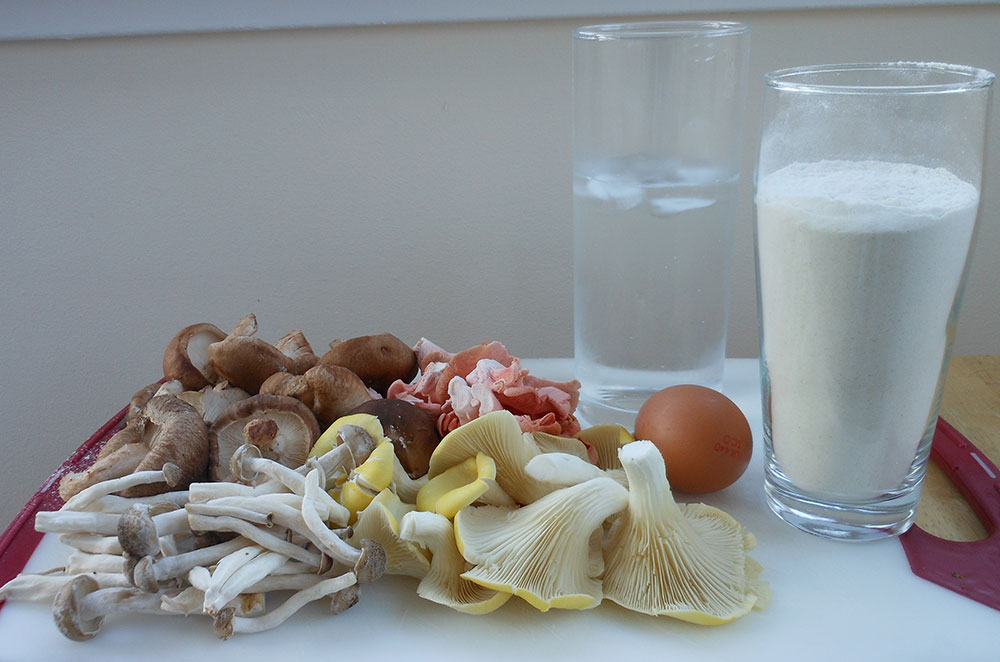
All ready to go
The ingredients are few and simple:
  • mushrooms (this time I used yellow oyster, pink oyster, shimeji and shiitake, and also added one white sweet potato)
  • 250g sparkling water
  • a few ice cubes
  • 250g white flour
  • an egg
  • salt
  • lots of olive oil
Pour the sparkling water into a glass and add the ice cubes. Put into the fridge for 10-15 minutes. Put the flour into the mixing bowl, make a depression in the middle, add the egg and salt. Start pouring the cooled water into the middle and mix with a whisk. The bubbles in sparkling water help to make a uniform mixture, so this is possibly the most important ingredient.

Heat up olive oil in a large frying pan on high heat until it starts smoking. Dip the first batch of mushrooms in batter, place on the frying pan (carefully!), wait for 1 minute or until they start turning golden, turn them over, wait for a further minute, take off the pan. Add more oil if necessary and repeat with the next batch.

Time to eat!
A few important pointers are worth remembering, to avoid spoilt food, personal injury and domestic fires:
  • make sure that the frying pan is really hot before dropping in the mushrooms, otherwise they'll turn out wet and squishy
  • be generous with oil
  • do not overcook the mushrooms
  • DO NOT LEAVE THE KITCHEN! (I've learned this one the hard way)
  • do not be alarmed if you point your camera at the cooked mushrooms and they trigger its face recognition feature: this is normal and is a sign of a good tempura 
Enjoy, and see you tomorrow for more mushroom stories!

Tuesday, 4 June 2013

Exotic mushroom sauce

Ingredients
Today's post, as promised, is a cooking report. This recipe is one of my favourites, because it works with any mushrooms. However, as mentioned in the previous post, it is especially great with firm-textured mushrooms that have strong flavour, and this time I had plenty of those!

Ingredients:

125g exotic mushrooms (mixture of yellow oyster, pink oyster and shimeji)
100g Scotch bonnet mushrooms
several shallots
a few garlic cloves
After adding the white wine
1 tablespoon of olive oil
glass of white wine
glass of double cream
bay leaf and peppercorns, salt

Method:

Heat the olive oil in a frying pan and add mushrooms and chopped shallots. Cook on medium high heat stirring frequently until shallots begin to soften. Add chopped garlic, bay leaf and peppercorns, keep stirring. After a minute or so pour in the wine.
Almost ready!
Increase heat to the maximum and wait for liquid to reduce by half. Transfer the mixture to a saucepan, stir in the cream, add salt if needed. Bring to the boil, then cover with lid, reduce the heat to the minimum and cook for a further 15-20 minutes. Turn off the heat and let the covered pot stand for 5 minutes or so. Serve with rice or pasta and green salad. It is best to eat it straight away, but it is also ok to reheat it the next day, or even use it as cold spread on toast.

The recipe will serve 2-3, if you need to feed more, just double the ingredients. Enjoy, and see you tomorrow!

Tuesday, 28 May 2013

Scotch bonnet risotto

Here they are, ready to go into
the risotto
Sorry if yesterday's post was frustrating. Someone told me that no one wishes to read about disappointments. However, I still think that a great part of the joy of hunting for wild food comes from not knowing whether a given trip would be fruitful. An occasional empty run is therefore essential, but nevertheless, here is a success story for a change.

As mentioned in the previous post, after I left the forest I went on to explore the local supermarket, and that's where I hit a motherload. Morels that I saw on my previous visit were gone, and instead the shelf was occupied by Scotch bonnets, marked for some reason as 'Mousseron'. Now, I have never picked these in the wild since I was not sure about their identification, so I was wary at first. But then I thought, hey, what good is my advice about 100% safe to eat fungi, if I wouldn't follow it myself? So I decided to give them a go.

In the pot... and on the plate
Given that they have rather small size, firm texture and distinctive sweet taste, the obvious recipe to use was a risotto. I followed Jamie Oliver's excellent instructions, adding the mushrooms at the stage when half of the stock was used up. Talking of the which, instead of standard vegetable stock I used porcini cubes that a friend got for me at Carluccio's. I was extremely pleased with the result, not just the taste, but the fact that Scotch bonnets worked really well with the al dente rice. Much better in fact than either button mushrooms or even ceps, so will definitely use these fungi again if I can get my hands on them.

They were safe to eat, too, as two days later I can feel no ill effects. Oh, wait, what was that stomach rumble?.. Nah, I'm fine, really.

But enough about edible mushrooms for now. This is not a cooking blog after all. I feel like I need to take time off from slaving in the kitchen and write about a rather fascinating poisonous fungus instead. Which one? Come back tomorrow to find out!

Wednesday, 22 May 2013

What to do with stale gorgonzola

Ingredients
Last night, thinking about my next post, I opened my fridge for snacks inspiration, and discovered that I had a fairly large lump of gorgonzola in it that was starting to go stale. My eye then fell on a pack of large flat mushrooms, and I knew what I had to do: combine large fungi with microscopic fungi in a delicious recipe. So here it is:


Ingredients:

4 large flat mushrooms (white or portobello)
All ready to go into the oven
100g of gorgonzola or any other blue veined cheese
a few cloves of garlic (optional)
1 tbsp of olive oil
bunch of flat leaf parsley or basil, to garnish

Process:

Chop the garlic, cut the cheese into small slices. Preheat the oven to 180C. Meanwhile, place the whole mushrooms with stalks removed in a fryng pan and fry them in olive oil for about 5 minutes, turning once. Remove from heat.

Lay out the mushrooms on a baking tray and place chopped garlic
Enjoy!
if using and cheese over each mushroom. Put the tray into the oven for 8-10 minutes. Garnish with herbs and serve while still warm.

Doesn't this look great? What's more, you are looking at guilt-free food. Mushrooms are not just tasty, they are good for you, and have a remarkably low calorie count. I'll write more on their extraordinary nutritional value in the next post.

Thursday, 16 May 2013

Morels in Scotland

Dreams...
Morels are rather notorious for causing severe cases of black envy among mushroom pickers. If you haven't found one in the wild, you can't help but consider yourself a second-class fungal citizen.

I am one of these unfortunate souls. Every spring I go through a period of typing "morels scotland" into Google, to find stories of people spotting the elusive delicacies next to parking lots, on landfill sites, in neighbours' gardens... the list of unlikely and excruciatingly mundane locations goes on.

I'll find them in the wild... someday.

... and reality
This year though I found them on a supermarket shelf, which is the next best thing. Fried with shallots in olive oil, they were delicious.

While searching for cooking instructions, I was reminded of the fact that morels are mildly toxic if eaten raw. What? Potentially poisonous fungi in a shop? There, now you know how dangerous it is to follow even the most self-evident rules of thumb when collecting mushrooms.

Stay safe, until next time!

Image credit: Black morels, used under the terms of Creative Commons Attribution 2.0 Generic license

Wednesday, 15 May 2013

To forage or not to forage?

That is, indeed, the question.

Prehistoric humans getting food
To get at an answer, we first need to consider, what is the attraction of wild food in the first place? In my mind, the most important are two things:

  • Wild mushrooms are free, just lying around, there for the taking.
  • Bringing home wild food delights the prehistoric man in each of us. "Honey, I brought you a mammoth," - life just doesn't get any better than that.

But, hang on. Are wild mushrooms really free? If you think about it for a moment, no, not really. Taking into account the cost of kit and travel, one kilogram of ready-to-eat mushrooms will cost you about £15. By comparison, shops will charge you about £20 per kilo. The extra £5 saves you hours of walking, tick bites and having to tell everyone you meet in the forest some combination of "I know what I am doing, thank you", "I will be very careful", "Sorry, I cannot teach you to identify mushrooms", and (my favourite), "Get your horse away from my basket!".

Modern human getting food
With the myth of "free food" busted, prehistoric man becomes surprisingly easy to tame. I still occasionally succumb to the call to explore the woods, but searching for interesting mushroom products in supermarkets is just as important, and good finds I make there give me just as much pleasure. Occasionally it even turns out to be something you do not see in the forest. One such recent find proved to be particularly special, and this will be the subject of the next post.

Image credits:
Le Mammouth by Paul Jamin, public domain;
Voyager golden record, image 77, public domain