Showing posts with label random fungi. Show all posts

Wednesday, 12 February 2014

Early arrivals, late encounters

Some early-flowering crocuses
Despite the current drop in the temperature (it was even snowing yesterday!), plant life is waking up. Snowdrops and aconites are out in huge numbers, and now later-flowering plants are joining them. Crocuses are now out, as well as a few butterburs, which I thought were summer flowers, but it looks like this year they were impatient to get out.

Impatient butterbur
Despite the relative abundance of flowers, there are still no pollinating insects in evidence, so I don't know what those early starts are hoping for. Must be invisible pink unicorns. They do exist, right?

Isn't it bedtime for your guys?
So, flowering plants are thinking that it's spring already, but fungi seem to be rooted in conviction that it's still late autumn. As evidenced by this fresh growth of sulfur tufts by the roadside.

Nature, you are not making any sense this year. Can you get your act together please?

Sunday, 26 January 2014

Winter surprises

First aconites on woodland floor
I don't know what has been happening with the weather this year. Spring seems to be continuing, and it's a very wet a windy one. In addition to snowdrops, the first aconites have appeared, and I don't think those can be fooled by a brief warm spell.

At the same time, I am still spotting a surprising number of late autumn fungi. Lots of common ink caps, and just today a troop of large brown fungi that looked a lot like soapy knights, Tricholoma saponaceum, but could be some other similar-looking species.

All this fresh growth has reminded me that it's only five months to go till next mushroom hunting season, and I have barely started on my stash of frozen ceps. So next post  will definitely feature them, and it will be soon!

Soapy knights (possibly), in tight formation.

Monday, 11 November 2013

Some parasitic fungi

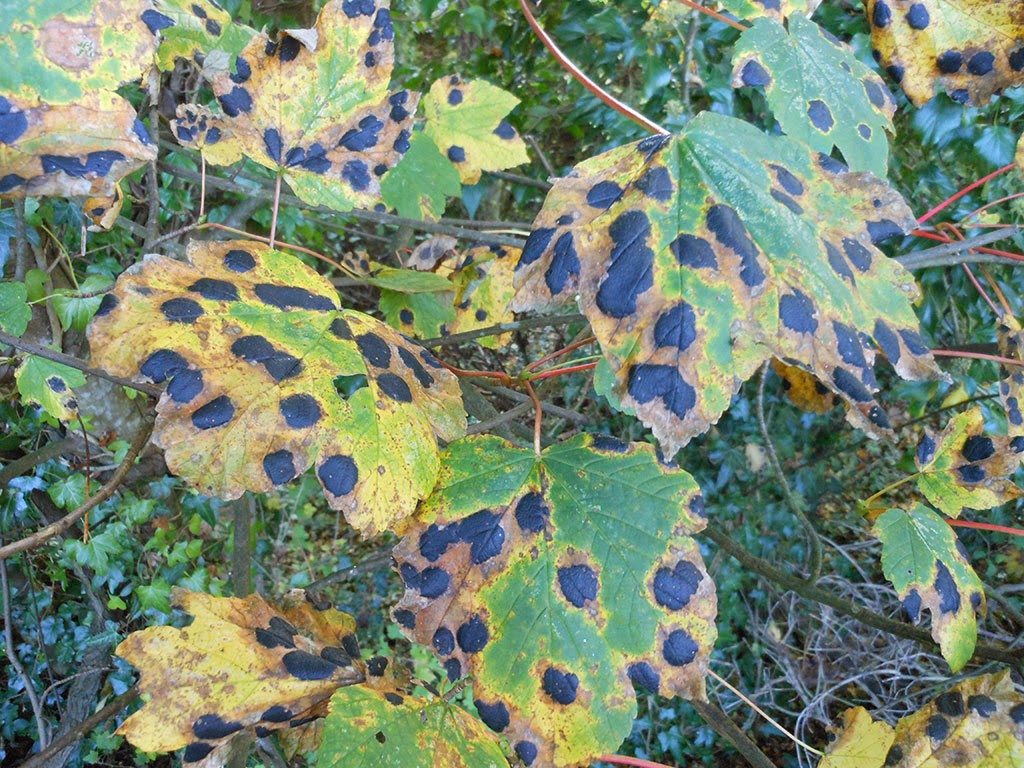
It's a fungus! Rhytisma acerinum
Autumn is almost at the end, with temperatures regularly dropping blow zero at night, but some fungal life is still in evidence. There are some "real" mushrooms on the ground, with stipe, cap, gills and everything, but the true abundance these days is found on tree leaves. It wasn't so obvious during the summer months, but it looks like all maples in the area are heavily infected with sycamore tarspot. Fortunately, it is quite harmless to the trees' long-term health, even though it looks horrible.

But at least, these fungi are feeding on plants, which is not so bad compared to the next photo:

The original of this image can be found here. It's a fungus eat fungus world out there!

Thursday, 31 October 2013

Mushrooms in late autumn

It has been a while since I posted some proper fungi spotting photos. Edible mushroom season is long gone, but quite a few tenacious fungi are still getting their heads above ground. Like this one, for instance:

Common cavalier, growing in leaf litter in mixed woodland
A couple of minutes later, while walking along a river bank under some very old pine trees, I found a big group of cavalier's relatives.

Clouded funnels. There were about a hundred of them on that spot!
Moving on, I found the only truly non-edible mushroom for today, growing on a rotting stump leaning over a stream. That's right, the two species above are edible, although not recommended due to combination of lack of taste and texture, possibility of confusion with similar poisonous species and occasional individual gastric reactions even if correctly identified.

A splash of colour - a welcome change from previous specimens. Brick tuft.
Beautiful, but not edible even when this young
Finally, right next to my office (did I mention that I took the pictures on my way to work today?), a company of ink caps, past their prime, but still looking good enough for a photo.

Remember: it's either eating these, or drinking alcohol. DO NOT combine!
All in all, not a bad photo collection for the last day of October! It has been very mild recently, with lots of rain, hence the relative fungal abundance. I'm sure I'll be back soon with more photos. Meanwhile, stay warm, and don't eat any funny mushrooms!

Friday, 25 October 2013

Mushrooms in the sky...

Or rather, mushroom-shaped cities with the base on the surface of the ocean, with their "caps" rising to 700 metres above sea level. I can't seem to stop thinking about "Green floats" these days.

Shimizu's arcologies may not be practicable, but I love their imagination and ambition. Also, we really need to do something with all that rubbish floating in the ocean. Dealing with the issue by constructing humongous mushrooms is bizarre but also strangely appropriate. After all, fungi are great recyclers. In a video that I posted a while ago, Paul Stamets listed six ways in which fungi can save the world. This might just be the seventh.


Monday, 14 October 2013

Unexpected finds in Glasgow city centre

This weekend I decided to give myself a bit of rest from any fungal delights (there really can be too much of a good thing) and instead of my usual forest walk went to Glasgow, thinking that I'd be safe among its concrete and stone.

All went well for a while, but then I lost my guard and went through a tiny bit of green space, just a stone's throw away from George Square. The next thing I knew, I was ambushed by this:

A brown birch bolete. In case you have any doubts, that is hosta and rhododendron foliage in the background.
There were several more of these growing in a nice semi-circular formation that had a birch in its centre. The tree could not have been more than 10 years old.

A couple more steps, and I stumbled against a semicircle of these:

Woolly milk cap, associated with the same tree as brown birch boletes.

Already finding it hard to believe my eyes, I turning attention to a nearby pine, also about 10 years old, and got another surprise.


Ugly milk caps, highly prized and commercially gathered in Russia for pickling. Normally associated with mature pine

Following that semicircle, I went deeper into the rhododendron bushes surrounding the pine, and, and...


You've got to be kidding me

How is this even possible? OK, fly agarics that grow in Britain are too toxic to be of any recreational use, but a group of over 30 of them (out of which 17 can be clearly seen in this photo) has no place in the middle of Glasgow. There was that recent case of a psychiatric patient and magic mushrooms though... Maybe it's a tendency.

Much has been said about difficulty of cultivating mycorrhizal mushrooms, but the truth is, cultivating them is not difficult, just extremely random and unpredictable. My experience this weekend shows that, given the right conditions, a most extraordinary array of forest fungi can spring up just from a couple of trees that happened to carry bits of mycelium and were lucky enough to be transplanted to a spot where soil composition, structure, surrounding plants, temperature, moisture and sunlight were exactly right.

From which I conclude that growing forest mushrooms is not an entirely futile cause. We just have to keep trying.

Tuesday, 17 September 2013

Where to study mycology?

If only we knew how to cultivate this!
I am still on my fever run, you see, but things are gradually going back to normal. I thought, suppose I'm going to attempt to cultivate these amazing wild fungi, wouldn't it help with the project if I got some sort of formal mycological credentials?

Unfortunately, it looks like there are very few places where you could study mycorrhizal fungi in the UK (no wonder so few people can even spell the word right!). I find it surprising since advances in their cultivation can provide a cost-effective and valuable source of food.

However, in the real world - "Among the many specializations of microbiology, mycology is one of the smallest. Because it is a small, niche field, few education, training and career opportunities exist" (full text here).

Maybe, it's time to change that.