This is footage of spore emission tricks in a few fungi species. The hat-thrower fungus from my post two weeks ago makes a brief appearance at 01:18, although its unique ability is not commented upon. But we already know how great it is, right?
I have to say that slime moulds are no longer classified as fungi, and the "field mushroom" is either a bay bolete or a very similar species, but the sequences with the giant puffball and especially the earth star, in my opinion, more than compensate for these errors.
Warning: contains stinkhorn close-ups! Thus not quite safe for work.
Enjoy, and see you next week for yet more fungi-related tales.
Friday, 14 June 2013

Thursday, 13 June 2013
Fungi for better cider
 |
| Scientific research in progress (spot a PhD student) |
Mycorrhizal association between plants and fungi is a symbiotic relationship benefitting both partners. The plant provides the fungus with the sugars from photosynthesis, and the fungus carries soil nutrients to the plant roots, allowing the plant to feed from a much larger area than its roots actually cover.
The fungi are not all equal, and some species will give their symbiont plant more than others. The goal of the project is to find out, which ones. There are about 160 potted experimental subjects, all apple trees of the same cider-producing variety, most infected with specific species of fungi, and some in sterile soil. In the course of the next three years each of them will be evaluated for fruit yield, general health, and pathogen and pest resistance. One PhD student, Despina Berdeni, is charged with their care and making the required measurements. There are certainly easier ways to obtain a doctorate! I hope she and her lab get some free cider from Heinekken for all their hard work.
The full podcast can be found on the Planet Earth Online web site.
Image credit:
Horse-driven apple crusher in Jersey
Wednesday, 12 June 2013
The case of fly agaric
 |
| Belle of the woods |
And then, I got on the web to check my facts, and got confused. Whereas all mushroom identification guides I've come across unanimously list this fungus as both poisonous and hallucinogenic, a quick web search threw up several links where people were consuming fly agarics as food.
The trick, apparently, lies in boiling them for at least 15 minutes in lots of water. This removes both the toxin (muscarine) and the hallucinogens (ibotenic acid and muscimol). Afterwards, the mushroom can be fried in butter and has an "unusual nutty taste" which "makes you wish for more".
Interesting taste is not the only argument of the proponents for its food consumption. They point out that the fly agaric is available in large quantities, that there are lots of other foods we eat that are toxic raw (red kidney beans for instance) and that it is almost impossible to misidentify. All true! But then, given the large variation in toxicity, boiling may not be sufficient to detoxify some strains; in addition, they need to be kept separately from other mushrooms to avoid contamination with the spores, which are also toxic; and finally, collecting these fungi can be illegal. You fancy explaining to your local policeman that the 3 kilos of red-capped mushrooms in your basket are for family dinner? Me neither.
 |
| Giant fly agarics in Minecraft |
Links to some of the articles:
On the subject of fly agarics (this one is about what can happen if you do not cook them properly)
Image credit:
Image credit:
Tuesday, 11 June 2013
Exotic mushroom tempura
As promised in yesterday's post, here is the recipe for a mushroom tempura. Strictly speaking, it's not really a tempura, because in order to get one right, you have spend 10 years in training and pass a final exam in which you have to eat your own cooking creation and survive. Or am I confusing it with something else? Anyway, life is too short and I am lazy, so the dish I cooked yesterday should be called "battered mushrooms", but I call it tempura, and my friends know better than to object if they want to be fed.
The ingredients are few and simple:
Heat up olive oil in a large frying pan on high heat until it starts smoking. Dip the first batch of mushrooms in batter, place on the frying pan (carefully!), wait for 1 minute or until they start turning golden, turn them over, wait for a further minute, take off the pan. Add more oil if necessary and repeat with the next batch.
A few important pointers are worth remembering, to avoid spoilt food, personal injury and domestic fires:
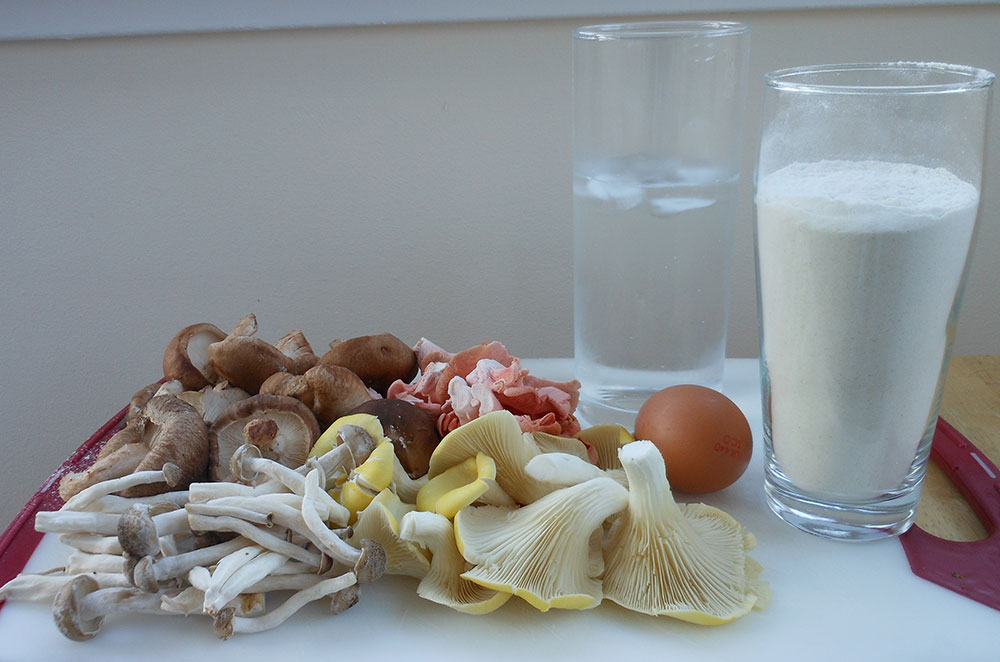 |
| All ready to go |
- mushrooms (this time I used yellow oyster, pink oyster, shimeji and shiitake, and also added one white sweet potato)
- 250g sparkling water
- a few ice cubes
- 250g white flour
- an egg
- salt
- lots of olive oil
Heat up olive oil in a large frying pan on high heat until it starts smoking. Dip the first batch of mushrooms in batter, place on the frying pan (carefully!), wait for 1 minute or until they start turning golden, turn them over, wait for a further minute, take off the pan. Add more oil if necessary and repeat with the next batch.
 |
| Time to eat! |
- make sure that the frying pan is really hot before dropping in the mushrooms, otherwise they'll turn out wet and squishy
- be generous with oil
- do not overcook the mushrooms
- DO NOT LEAVE THE KITCHEN! (I've learned this one the hard way)
- do not be alarmed if you point your camera at the cooked mushrooms and they trigger its face recognition feature: this is normal and is a sign of a good tempura
Monday, 10 June 2013
Mushroom season: on the approach
 |
| Look! They now grow in groups |
Still no chanterelles! However, things are definitely starting to look up: there was a spread of little brown toadstools pretty much everywhere under the spruce, and that means that the nice tasty fungi will follow before long.
So desperate was my longing for mushrooms that I took these two toadstools home and took a spore print, in the hope of making an identification. The spore print was rusty brown, which confirmed beyond any reasonable doubt that the specimen was a Little Brown Mushroom, Almost Certainly Not Safe To Eat. I knew that already of course, but it's always good to be sure.
So, in the end I had to go for Plan B, the local supermarket. I wish I had a Plan C, because while I was snapping pictures of the toadstools in the forest, the shop ran out chanterelles, which were this week's wild mushroom on offer. What? Competitors on my spot! Arrgh. They must have been reading this blog. I had to console myself with oyster mushrooms and shiitakes. OK, it could have been worse: they are perfect for tempura, and cooking report will follow tomorrow.
Subscribe to:
Posts (Atom)