Videos as these, in my opinion, do not help in identifying edible mushrooms. Indeed, it is rather dangerous to go wild mushroom foraging armed with just the information they give. Good printed field guides and reference books are much more useful in this respect.
So why am I posting this? Because it gives me great pleasure to see someone pick edible mushrooms and put them into his basket.
Enjoy the video, and see you next week, for more mushroom stories.
Friday, 9 August 2013

Thursday, 8 August 2013
Lactarius indigo
 |
| It really looks like this |
Two amazing things about it:
- this is not Photoshop
- it's edible!
Unfortunately, it doesn't grow in Scotland, just in Mexico and Guatemala. I so wish I could add this splash of colour to my basket...
Image credit:
Lactarius indigo
Lactarius indigo
Wednesday, 7 August 2013
Beatrix Potter, a Victorian naturalist
 |
| Souvenirs from the Armitt Museum |
Now, everyone knows that she is a highly acclaimed children's author, the writer who brought to us the tales of Peter Rabbit and his friends, in which charming and simple text is accompanied by beautiful illustrations. In my opinion, these illustrations are a major factor in the success of her books, as it is thanks to them that the stories and characters in them are really brought to life.
 |
| Illustration to "The Tale of Squirrel Nutkin" (spot the mushrooms!) |
It must have been a great disappointment for her, but there is something we have to thank those eggheads. I am sure that their refusal to publish her paper spurred her to try her hand at a different kind of publication, and a good children's book is much better than any scientific paper, especially one that actually has such significant educational value: her illustrations of plants and English countryside are extremely accurate, even though her description of animal habits is certainly not! I am deeply saddened though that one thing is missing from them: fungi. Except for one illustration to "The Tale of Squirrel Nutkin", all she ever drew for Peter Rabbit was plants. Perhaps that experience at the Linnean cut deeper than her biographers thought, as after it she gradually stopped producing fungi drawings altogether.
Tuesday, 6 August 2013
Chanterelle rice with wholegrain mustard
This is a simple recipe for the times when wild mushroom pickings are scarce. Just a handful of chanterelles adds lots of flavour to the rice base, and makes a great addition to sausages or steak.
Ingredients:

 |
| Ingredients |
- a handful of chanterelles
- one small onion
- two cloves of garlic
- 200g rice
- 2 tsp wholegrain mustard
- salt to taste
- 1 tbsp olive oil
- 2 tbsp sherry
Process:
 |
| Chanterelle mixture - ready to be added to the rice |
Finely chop onion, garlic and chanterelles. Heat olive oil in a frying pan, add onions, cook on medium heat until they start to soften. Add chanterelles, cook until all water evaporates, occasionally stirring. Add garlic, cook the mixture for 1 further minute and add sherry. Once it is absorbed into mushrooms, reduce the heat, add the mustard and salt, stir well. After 2-3 minutes turn off the heat and set aside.
Cook your rice using your preferred method. I normally use Delia's, but obviously without onions, since they are already present in the chanterelle mixture.
Once the rice is almost cooked, fluff it with a fork as Delia suggests, and add the filler, mix well and let it stand for 10-15 minutes before serving.
Here is what it should look like at the end - enjoy!

Monday, 5 August 2013
Things are picking up
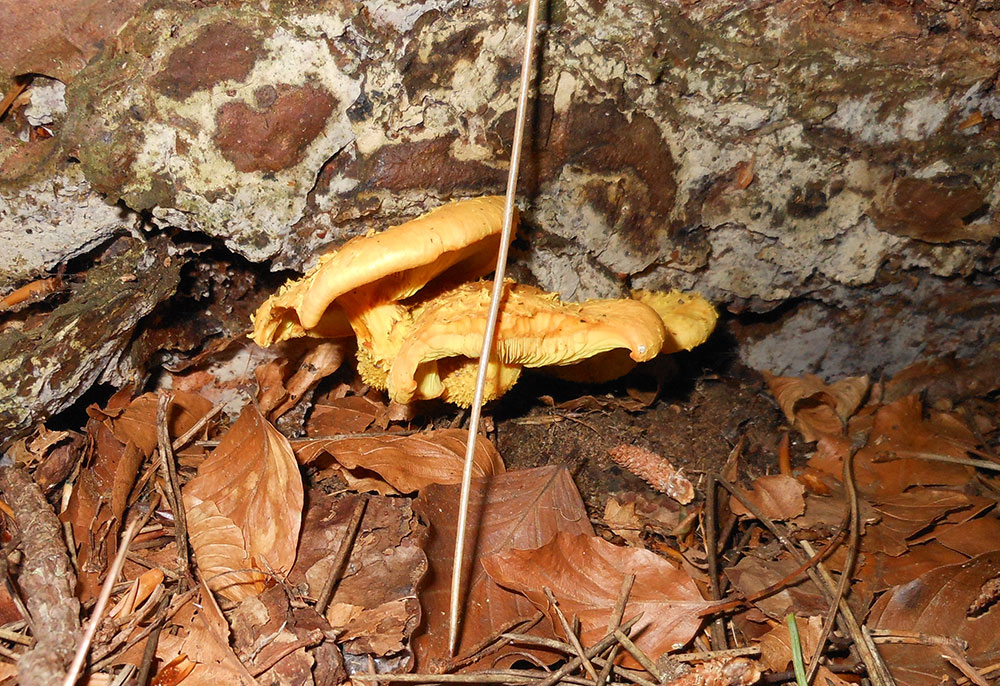
Don't get me wrong, it wasn't a very successful trip by any standards, especially taking into account it's early August - this time in previous years, ceps and other edible boletes used to ambush me left and right and middle. As it happens, after 5 hours' walk I only brought home a handful of chanterelles. But, something is definitely changing in the forest - see for yourself.
Firstly, I found these white fungi, next to an old beech, growing among dead wood. Never seen them before! The closest match in my reference book is Clitopilus scyphoides, but it's not really funnel-shaped, so must be some lookalike.

Next, came a couple of specimens of flaming scalycap growing from underneath a rotting conifer trunk.

Then, some little brown mushrooms, cucumber tuft or something very similar.

After that, some even littler white mushrooms, at whose ID I cannot even give a stab:

And, finally - something edible:

Last but not least, in the darkest and wettest part of the woods, a grey spotted amanita. Its edibility is suspect, and in any case it shouldn't be eaten because of the possibility of confusion with deadly poisonous Amanita phalloides and Amanita pantherina. However, its appearance suggests that the conditions are finally right for larger mushrooms to appear. It probably means that next week I'll finally bring home a cep!

And, just to wrap up, the result of the day:

Small in number, but big and juicy, and I have plans for them which involve rice and wholegrain mustard.
Stay safe, don't eat any strange mushrooms, and I'll see you tomorrow for the recipe!
Firstly, I found these white fungi, next to an old beech, growing among dead wood. Never seen them before! The closest match in my reference book is Clitopilus scyphoides, but it's not really funnel-shaped, so must be some lookalike.

Next, came a couple of specimens of flaming scalycap growing from underneath a rotting conifer trunk.
Then, some little brown mushrooms, cucumber tuft or something very similar.

After that, some even littler white mushrooms, at whose ID I cannot even give a stab:

And, finally - something edible:

Last but not least, in the darkest and wettest part of the woods, a grey spotted amanita. Its edibility is suspect, and in any case it shouldn't be eaten because of the possibility of confusion with deadly poisonous Amanita phalloides and Amanita pantherina. However, its appearance suggests that the conditions are finally right for larger mushrooms to appear. It probably means that next week I'll finally bring home a cep!

And, just to wrap up, the result of the day:

Small in number, but big and juicy, and I have plans for them which involve rice and wholegrain mustard.
Stay safe, don't eat any strange mushrooms, and I'll see you tomorrow for the recipe!
Subscribe to:
Posts (Atom)