Friday, 27 September 2013

More mushroom cultivation

Lately I have been thinking more and more of it - and accordingly, watching videos on how it's done. Here is how they do it in California (not that it's different from anywhere else!)

The essential steps to growing mushrooms, according to this video, are:

- making mushroom compost
- peak-heat
- spawning
- casing
- pinning
- harvesting

Enjoy, and see you next week for more mushroom stories!


Thursday, 26 September 2013

Which kind of chanterelle?

Early chanterelles
A recent news article raises an interesting issue, which is that many mushrooms that we normally think of as a single species, are not. Kathryn Perez and Matthew Foltz proved by DNA analysis that golden chanterelles growing in Hixon Forest in Wisconsin are in fact three different species, and not merely colour variants.

Chanterelles are mushrooms that I collect every foraging trip, and one thing I have been puzzled about is how long their fruiting season is. It starts in mid-June and continues until mid-October, and sometimes even later if there is no ground frost. No other fungus in the local forest covers even half of that span.


Over these four months, it does not fruit everywhere though, but rather there are "early" and "late" spots, and the mushrooms from these do have a difference in appearance. Early chanterelles are typically smaller and lighter in colour, with cream stems and wavy false gills. Later in the year, I see only yolk-coloured, larger fungi.

Late chanterelles
Previously, I thought that the difference in shape and colour is explained by the variance in conditions in which these chanterelles grow, temperature- and humidity-wise, but I realise now that their emergence in different spots probably does mean that they are distinct species.

Not sure about one thing though - the article says, "Documenting the new species, their locations, and physical differences including taste, will be of interest to the culinary industry". I am no mycologist, but I have cooked a lot of chanterelles in my life. You can trust me on this: these mushrooms might look different, but THEY ALL TASTE THE SAME!

Wednesday, 25 September 2013

Beef stroganoff with wild mushrooms

Ingredients
With the unique crop I brought home last Sunday, I thought I needed to do something special, and taking upon the challenge of cooking an edible beef stroganoff seemed just right.

Ingredients were as follows:

- 300g rump steak, cut in thin strips
- flour, to coat the above
- 100g shallots
- a few cloves of garlic
- large glass of white wine
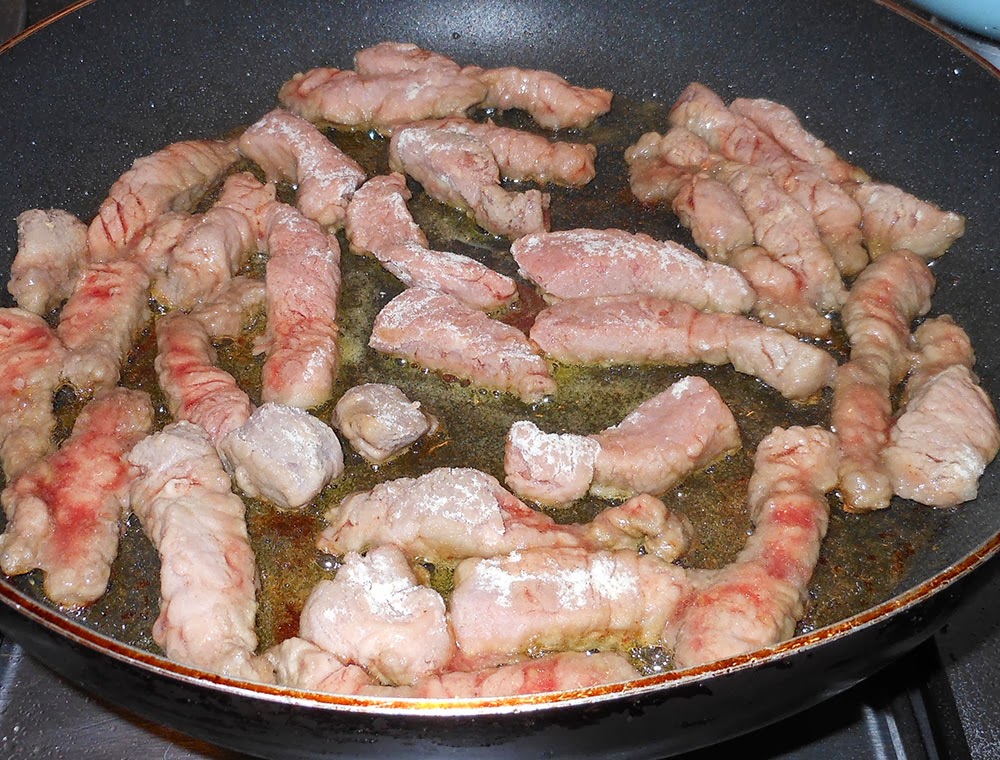
The right way to fry meat
- 100g single cream
- sage, bay leaf, peppercorns
- 1 cube of porcini stock (but vegetable stock would do just fine)
- herbs, to garnish

Now, am I missing something? Oh, yes, and of course:

about 300g of finest wild mushrooms as found in Scottish forests. I have used ceps, slippery jacks, one brown birch bolete and a few hundred amethyst deceivers. But if you can't get those, plain chestnut mushrooms will do just fine.

The main ingredient
Process:

Coat the meat in flour, and throw on pre-heated frying pan. Fry for a few minutes on high heat, turning once. The meat must brown slightly, but must NOT be cooked through. This is very important as otherwise it'll stay tough, no matter how long it is stewed afterwards. In another pan, fry the halved shallots, sliced garlic and sage leaves, on medium heat. Once the meat has browned, add it to the shallots. Make sure you scrape all the delicious crispy bits from the pan into the pot. That's what will make the stroganoff taste so good!


Last stage, 30 minutes before end
Turn the heat up and pour in the wine. Dissolve the stock cube in 0.5l of boiling water and pour it all in. Cover the pot with heavy lid and simmer on medium low heat.

Meanwhile, clean and wash the mushrooms. Add them to the pot after 1 hour, and cook for a further 30 minutes. Add the cream, bring to the boil, and you are done!

Serve with chips or roast potatoes and fresh herbs. Bon appetit!

Note how the tiny laccarias keep their purple colour in the stew. These little beauties are amazing!

Tuesday, 24 September 2013

Amethyst deceiver

Laccaria amethystina does not typically get good reviews regarding its edibility. Most sources list it as mediocre, or even hardly worthwhile. It's true that it's a rather small mushroom, with fairly tough texture and not very distinctive taste. However, it is very special for me. Its taste may not be great, but I love it for the fact that it presents a mushroom hunter with a serious challenge. And for its colour, of course. But challenge still comes first.

Now, anyone can identify and pick ceps. They are very large, highly visible mushrooms that you can't miss. Chanterelles are a bit more tricky because they are smaller, and in autumn the leaves of birch, their favourite tree, take on the same colour, and therefore looking for them a bit more difficult.

Amethyst deceivers take the challenge up a few notches. Considering their bright purple colour, you might think that it's not a big deal, but spotting their fruit bodies on beech leaf litter is next to impossible, partly due to their small size, but mostly because in the tree shade the brown of leaves and the purple of mushrooms don't look at all different.

So, if you managed to bring back home a crop of these beauties, you can call yourself an expert mushroom hunter. And how to cook them? Come back tomorrow to find out!

Image credit:

Monday, 23 September 2013

Forest gems

Late September is the end of mushroom season in Scotland, so when setting out on my usual route this Sunday I wasn't expecting much to put into my basket. On a day like that it hardly matters though: the walk would have been rewarding even without any finds. Sunshine, gentle wind, the smell of heated pine needles, a few mosquitoes... OK, mosquitoes were not a welcome thing, but that's what insect repellent is for, right?

For the first couple of hours, I was only finding false chanterelles, lots of them. Very fine specimens, though:

If only it were real! Note the crowded forked gills that distinguish this fungus from the true chanterelle.
I could have picked hundreds of them, but alas - they are quite inedible, although not bad-looking, I must admit.

Then, finally something to put into my basket. Nearly stepped on it!

Small, but firm and maggot-free
An hour later, a nice find on a mossy forest path. I'm not greatly excited by brown birch boletes, but so late in the mushroom year, attitudes change.

No time to be fussy! Get into the basket, my friend.
On the final stretch, the path took me through an ancient beech wood, where the leaf litter layer was so thick that it was like walking on a mattress. And there I found them! Several hundreds of fresh, shiny, purple amethyst deceivers, Laccaria amethystina. Also, a few true chanterelles mixed up with them as a bonus, and a small cep, too!

Gem of the woods: extraordinary colour (and yes, it is edible)
I'll write more about these beautiful fungi later this week. They made my day!

The complete crop: top left - brown birch boletus; top - two slippery jacks; right - a couple of hundred of amethyst
deceivers; centre - saffron milk cap (sadly, all maggoty despite to good looks); bottom - golden chanterelles;
bottom left - two ceps. An excellent haul, considering the timing. Cooking report coming up!