Monday, 7 October 2013

Mushroom gardening

Shaggy scalycap, growing under
a cherry tree - a beautiful sight
Mushroom season is clearly at an end. Mycelium in Scottish forests has exhausted all its stored nutrients, and thus very few new fruitbodies are produced. There might still be some stray bay boletes and pearl puffballs popping out, so I might make one or two more foraging trips this year, but this looks like a good moment to put this blog into a winter mode, with three posts a week instead of five.

It has been a reasonably good season. Not as amazingly spectacular as promised by national news back in August, but I still managed to stock my freezer with a few kilograms of fine porcini, not to mention all the fresh wild mushroom dishes that I'd cooked for my long-suffering family over the summer and early autumn. They are openly relieved that wild fungi will be off menu for a while!

There is no longer any pressure to bring home "the goods", so it was easier to pay more attention to purely aesthetic qualities of fungi I encountered. It is curious that while the edibles are all but spent, all other kinds just keep jumping out of the ground, adding colour and texture to parks, lawns and gardens. Consider the scalycap fungus pictured above: I found it at the edge of a communal garden, and it certainly looks like someone planted the flowers around it to create a perfect composition, in anticipation of its emergence as the centrepiece of the floral composition.

A group of Paxillus validus
Or take the next picture, a group of Paxillus validus, lovely brown and golden fungi (closely related to brown roll rims) that I spotted growing next to the Riverside museum in Glasgow this weekend. The area where they are sprouting has only recently been developed, and as such it only features fairly small tree saplings on standard-issue grass cover. How fortunate that the roots of those saplings were carrying fungal mycelium! It will take many years for the place to become a real park, but in the meantime the mushrooms successfully manage to break the monotony of generic planted landscape, and make the place look so much closer to nature.

Decorative mushroom gardening? Not as preposterous as it sounds!

Friday, 4 October 2013

Fantastic fungi

I have to confess that I absolutely love time-lapse videos of growing fungi, and the one below, featuring Paul Stametz, is in my opinion one of the finest of its kind.

I have to say that do not agree with his view that nature is "intelligent": it is true that it is a very intricate system that can do very complicated things (maintaining balance in ecosystems is one that immediately comes to mind), but it certainly does not possess intelligence in the way humans do.

However, I admire his dedication to all things fungi, and greatly looking forward to the mushroom paradise that he is promising to mankind.


Thursday, 3 October 2013

If you are normal...

Some mushrooms
are better left alone
... you go searching for mushrooms. No, really - according to this article. I read it with a mixture of pleasure and annoyance. Pleasure - because people in the US are finally recognising that not all mushrooms are evil, and that wild mushroom pickers are not necessarily prospective patients of psychiatric hospitals (the title definitely suggests that it is a possibility).

Annoyed, well - so many reasons. Firstly, why do you have to pay 200 bucks a day to hire a mushroom guide? Seriously, you pay me that much, and I'll show you ALL my mushrooming spots. Any takers? Hmm, ok, moving on.

The main annoyance is the tone of the article of course - hey, look, these weird Russians, they don't even know how to cook mushrooms properly! Also, the reference to WWII was rather inappropriate. "anti-tank trenches[...], which are ideal for mushrooms". Those trenches were created during the Siege of Leningrad. I'd find some other place to pick my mushrooms, just to avoid those ancestral memories. Of course, you cannot expect an American to understand that. After all, they still believe that they won that war...

Image credit:
Anti-tank obstacle and plaque: "Front line of Leningrad defence. 1941-44"

Wednesday, 2 October 2013

Brown roll rim

Paxillus involutus
Many people are scared of poisonous fungi such as death caps, or destroying angels, or deadly web caps, which kill you quickly, painfully, and reliably. Fungal poisoning though can be more subtle than that. Meet the brown roll rim, the fungus that could kill you after you'd eaten it one hundred times with no ill effects. That one last time, it causes an autoimmune reaction in its victims that destroys red blood cells, ultimately causing kidney failure. It is not a cumulative poison, as some sources suggest. The exact reasons why some, but not all, instances of brown roll rim consumption result in serious illness, are not known.

Because deaths by brown roll rims are so rare, the toxicity of this mushroom has not been recognised until recently. Indeed, in parts of Central and Eastern Europe it is still consumed, sometimes in great quantities, as evidenced by the photo below.

Looks great, but these are not for me
I have to admit that this species highlights a serious issue with wild food generally: in truth, you never can have a total guarantee that the stuff you bring in from the forest is safe. There are no biological, chemical or radiological controls to reassure you, unlike in big supermarkets (although, the recent horsemeat burger scandal shows that even their procedures are not 100% reliable).

Fortunately, with properly identified edible mushrooms the risk is minimal. But brown roll rims? No matter how inviting that pot of cooked mushrooms looks, I'm giving it a miss.

Image credits:
Paxillus involutus
Cooked brown roll rim (personal communication)

Tuesday, 1 October 2013

Meanwhile, in the East...

Mushroom season here in Scotland is ending, but this is clearly not the case in other places. Consider this foraging report I got from a friend in Germany:

Ceps, lurid boletes and a few bay boletes - very nice haul!
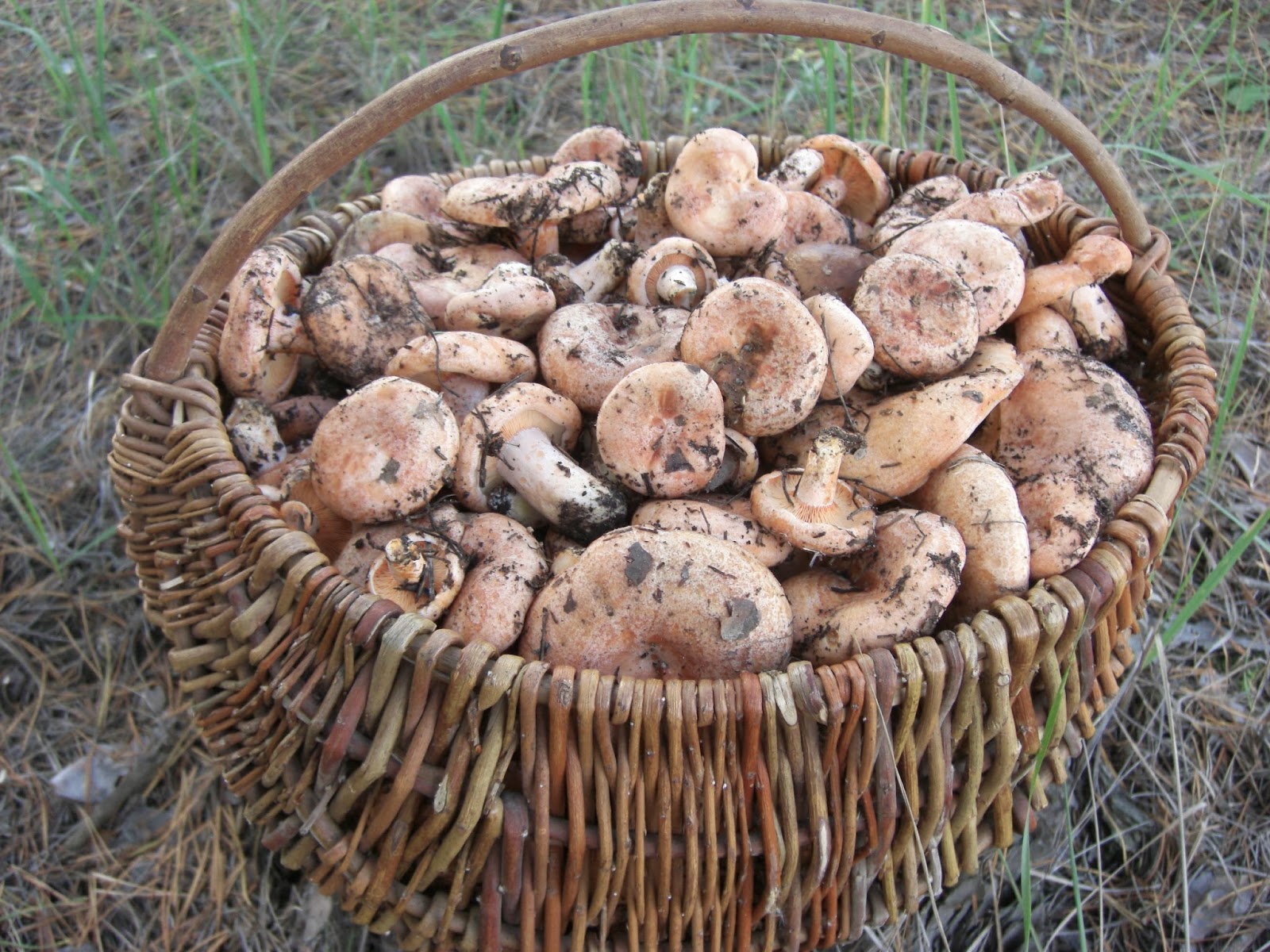
But it is the Ukrainian report that makes me truly jealous. Saffron milk caps. SAFFRON MILK CAPS!!

Maybe I'm living in a wrong country...